

How to Tell If CBD Is Good Quality
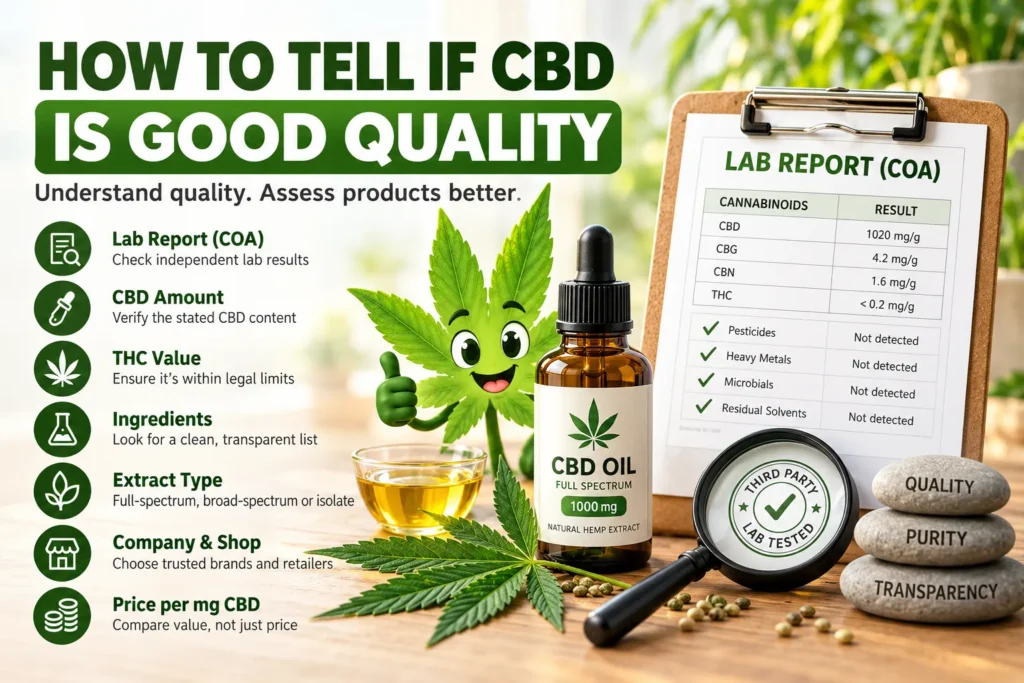
Good-quality CBD cannot be identified from premium packaging, a high price or marketing words alone. A product becomes easier to assess when its identity, batch, composition, laboratory documentation and responsible company can be matched consistently.
This page explains the documentation and transparency signals behind CBD product quality. It does not recommend a product, dosage or method of use.
- This guide: product identity, batch traceability, composition, laboratory scope, labeling and responsible-company transparency.
- COA details: how to read a CBD Certificate of Analysis.
- CBD basics: What Is CBD?
- CBD and THC: compound differences and THC-related claims.
- Extract types: full-spectrum, broad-spectrum and CBD isolate.
- CBD oil: strength, carrier oils and label terminology.
CBD Quality Means More Than a High CBD Percentage
A percentage mainly describes concentration. By itself, it does not show whether the product is clearly identified, connected to the correct laboratory report or fully documented.
A useful quality check looks at several layers together: product identity, composition, batch traceability, laboratory scope, labeling and the company responsible for the finished product.
| Quality Area | What Should Be Clear | Typical Gap |
|---|---|---|
| Product identity | Name, variant, quantity and product type agree across documentation. | Product page, label and laboratory report describe different variants. |
| Batch | A batch or lot number connects the product with its documentation. | Only a generic report is available with no connection to the product. |
| Composition | CBD amount, extract type, carrier or base and other ingredients are identified. | Marketing language replaces clear ingredient information. |
| Laboratory scope | It is clear which parameters were actually tested. | A cannabinoid table is presented as complete quality testing. |
| Traceability | A manufacturer, importer, distributor or responsible seller can be identified. | No clear company is responsible for the product. |
| Consistency | Product page, packaging and supporting documents do not contradict one another. | Different quantities, strengths or product names remain unexplained. |
Product Page, Label and COA Should Describe the Same Product
A CBD quality check starts by matching the product identity. The name on the product page should agree with the packaging and laboratory documentation. The same applies to strength, bottle or pack size, flavour or variant and extract type.
Compare the product name, variant, quantity and batch number across the product page, label and COA. A laboratory report for another strength or product does not automatically document the item being sold.
Minor differences in wording can occur. The important question is whether the product can still be matched clearly and consistently to its supporting documentation.
Batch Traceability Makes CBD Quality Easier to Verify
A batch or lot identifies a particular production run. Matching that number to laboratory documentation helps establish whether the published results relate to the product being assessed.
- Batch number on the product: it should be legible and associated with the physical item.
- Batch number on the COA: it should match the product where batch-specific testing is claimed.
- Test date: helps place the report in the context of the production batch.
- Product description: strength, variant and quantity should be clearly identifiable.
For the detailed meaning of report fields, units and analytical limits, see CBD Certificate of Analysis (COA).
Cannabinoid Testing Is Only One Part of Quality Control
Many CBD laboratory reports focus on CBD, THC and other cannabinoids. That information is useful, but a cannabinoid profile is not automatically a complete quality or contaminant assessment.
| Possible Test Area | What It May Show | What to Check |
|---|---|---|
| Cannabinoid profile | Measured CBD, THC and potentially other cannabinoid values. | Unit, result, analytical limit and relevant batch. |
| Heavy metals | Whether the sample was tested for specified metals. | Which metals were included and how results are reported. |
| Pesticides | Whether selected pesticide residues were tested. | The scope of the analyte list and the reported results. |
| Microbiology | Whether specified microbial parameters were included. | Which organisms or total-count measures were tested. |
| Residual solvents | Whether selected manufacturing-related solvent residues were tested. | Which solvents were part of the laboratory panel. |
Not every product requires the same testing plan. A missing test panel should therefore not be interpreted automatically as proof of poor quality. The important point is that the actual testing scope is described accurately rather than overstated.
CBD Amount, Extract Type and Ingredients Are Separate Quality Checks
CBD amount, extract type and the ingredient list answer different questions. Concentration describes how much CBD is stated, while extract type describes whether the CBD ingredient is full-spectrum, broad-spectrum or isolate-based. The ingredient list describes the finished formulation.
| Information | What It Explains | What It Does Not Replace |
|---|---|---|
| CBD percentage | CBD concentration. | Total amount, ingredient list or batch documentation. |
| CBD in milligrams | CBD amount in a bottle, pack or individual unit. | Verification of the full composition. |
| Full-spectrum, broad-spectrum or isolate | The type of CBD ingredient or extract profile. | A matching COA and full ingredient information. |
| Carrier oil or base | The main base of the formulation, such as MCT or hemp seed oil. | CBD and THC laboratory results. |
| Flavourings and additives | Additional ingredients in the finished product. | Batch traceability or laboratory matching. |
The differences between extract types are explained in Full-Spectrum vs Broad-Spectrum vs CBD Isolate. For percentages, milligrams, millilitres and carrier oils, see CBD Oil.
Labeling and Packaging Are Part of Product Quality
Product quality also includes whether an item is clearly identified and packaged in a way that preserves readable product information. Attractive packaging alone is not evidence of a high-quality formulation.
- Product name and variant: should be clearly identifiable.
- Quantity or fill volume: the amount of product should be stated.
- Batch or lot marking: connects the physical product with supporting documentation.
- Ingredients: the composition should be presented clearly.
- Storage information: should provide the manufacturer’s relevant storage instructions.
- Responsible company: the manufacturer, importer, distributor or other responsible business should be identifiable where applicable.
Professional-looking packaging becomes a useful signal only when the information printed on it is clear and consistent with the product page and supporting documents.
Company Transparency Matters
It should be possible to identify which business manufactures, imports, distributes or is otherwise responsible for the product. That information becomes especially useful when a batch, COA or conflicting product claim needs to be clarified.
Company information on the product, packaging and seller website should not create unexplained contradictions. The exact legal labeling requirements vary between countries and product categories.
Quality Signals vs Marketing Signals
| Claim or Feature | How to Interpret It |
|---|---|
| “Premium CBD” | Marketing language unless supported by specific, verifiable information. |
| “Natural” | A broad marketing term; composition and processing still need separate assessment. |
| High CBD percentage | Describes concentration, not overall product quality. |
| Batch-specific COA | A useful documentation signal when the report clearly matches the product. |
| Complete ingredient list | A useful transparency signal. |
| Identifiable responsible company | Supports traceability and follow-up questions. |
| Large discount or countdown timer | A sales signal, not evidence of CBD quality. |
A Simple CBD Quality Checklist
No single score can prove CBD product quality. A simple matrix can, however, make missing documentation easier to spot.
| Check | 0 Points | 1 Point | 2 Points |
|---|---|---|---|
| Product identity | Unclear or contradictory. | Partly identifiable. | Clear across product page, label and documents. |
| Batch traceability | No batch connection. | Batch stated but matching is unclear. | Product and COA clearly connected. |
| Composition | Important information missing. | Basic information available. | CBD amount, extract type, base and additives clearly stated. |
| Laboratory scope | No report. | Limited or generic report. | Scope, values and analytical limits are transparent. |
| Responsible company | No identifiable company. | Only partly clear. | Manufacturer, importer, distributor or responsible seller clearly identified. |
| Consistency | Several contradictions. | Minor unresolved points. | Product page, packaging and documentation agree. |
The score is not a certification or quality seal. It is simply a way to highlight documentation gaps. A high score does not establish medical effectiveness, individual suitability or legal approval.
What Good CBD Quality Does Not Prove
Even a well-documented CBD product does not prove a particular effect for an individual person. A laboratory report describes the tested sample and the parameters included in that analysis.
Product quality and legal status are also separate questions. Rules can depend on the product category, composition, intended use and jurisdiction.
This page assesses the transparency and consistency of product information. It does not recommend CBD use, dosage or medical application.
Which CBD Wiki Topic Should You Read Next?
| Question | Next Topic | Main Focus |
|---|---|---|
| How do I read a COA in detail? | CBD Certificate of Analysis | Batch, test date, units, CBD, THC, ND, LOD and LOQ. |
| What is CBD? | What Is CBD? | Cannabidiol, hemp and basic product terminology. |
| How do CBD and THC differ? | CBD vs THC | Compound differences and THC-related claims. |
| What cannabinoids may appear in a lab report? | Cannabinoids | CBD, THC, CBG, CBN and acidic forms. |
| How do extract types differ? | CBD Extract Types | Full-spectrum, broad-spectrum and isolate. |
| How do I interpret CBD oil strength? | CBD Oil | Percentages, milligrams, bottle size and carrier oils. |
| Where does the English CBD knowledge base begin? | CBD Wiki | Central overview of SaveSleuth CBD guides. |
CBD Quality in Simple Terms
A well-documented CBD product should be easy to identify and trace. The product page, label and laboratory report should describe the same product, while the batch, CBD amount, extract type, ingredients and responsible company should be clear.
Marketing claims, high concentrations and premium pricing are not enough on their own. The strongest quality signals are specific details that can be checked against the physical product and its supporting documentation.
← Back to the CBD Wiki | CBD Certificate of Analysis | CBD vs THC | Cannabinoids | CBD Oil
Frequently Asked Questions About CBD Quality
How can you tell if CBD is good quality?
Useful quality signals include clear product identity, batch-specific documentation, a complete ingredient list, understandable laboratory information and an identifiable company responsible for the product.
Is a Certificate of Analysis enough to prove CBD quality?
No. A COA is important, but it only reports the parameters tested in a particular sample. Product identity, batch matching, ingredients, labeling and traceability should also be checked.
Does a higher CBD percentage mean better quality?
No. A higher percentage describes concentration. It does not prove that the product is better documented, more transparent or more thoroughly tested.
Why is the batch number important on a CBD product?
A batch number helps connect a particular product with its production lot and supporting laboratory report. Without that connection, a published COA may relate to different stock.
Are terms such as “premium” and “natural” signs of CBD quality?
Not by themselves. They are broad marketing terms. Specific information such as batch identification, ingredient details, laboratory scope and product traceability is more useful.
Does good CBD quality prove that a product will work?
No. Product documentation and quality do not prove a particular medical effect, individual response or legal status.