

Cannabinoids: CBD, THC, CBG and Other Compounds Explained
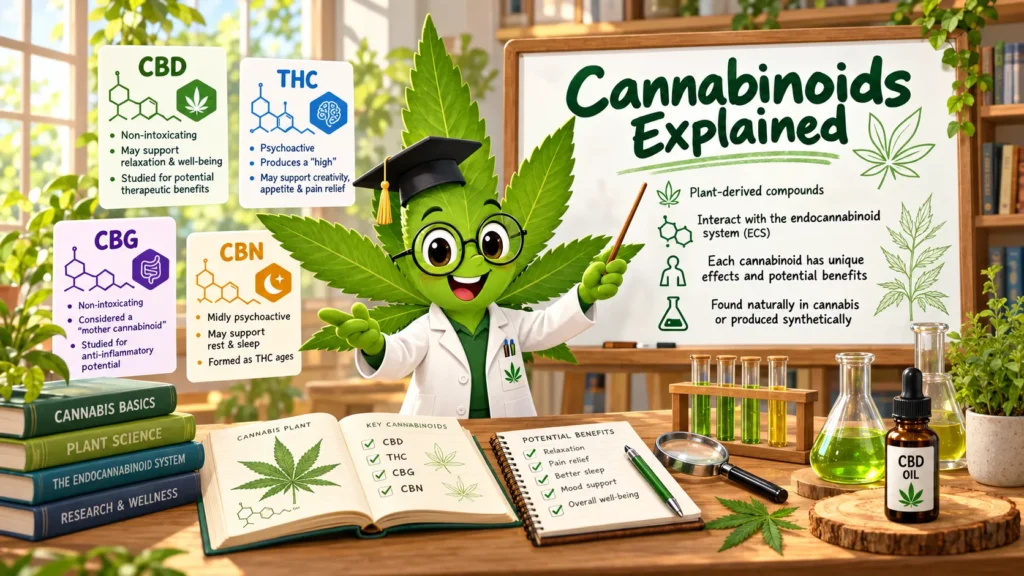
Cannabinoids are a group of chemical compounds. They include plant-derived cannabinoids such as CBD and THC, naturally occurring endocannabinoids in the body and cannabinoids produced synthetically.
This page explains the cannabinoid family, common abbreviations, acidic precursor forms and cannabinoid profiles. Detailed effects, legal rules, extract types and laboratory interpretation are covered separately.
- This guide: cannabinoids as a compound group, major categories, abbreviations, precursor forms and cannabinoid profiles.
- CBD basics: What Is CBD?
- CBD vs THC: differences, intoxication and perception.
- Extract types: full-spectrum, broad-spectrum and CBD isolate.
- Laboratory results: COAs, units, detection limits and batch-specific cannabinoid values.
- Legal context: depends on the individual product and jurisdiction.
What Are Cannabinoids?
Cannabinoids are chemical compounds grouped together because of their origin, structure or interaction with components of the body’s cannabinoid-related systems. In the CBD market, the term most often refers to plant-derived cannabinoids from Cannabis sativa L..
CBD is a cannabinoid. THC is also a cannabinoid. CBG, CBN, CBC, CBDV and THCV belong to the same broader group. Being members of the same compound family does not mean that they have identical properties or are classified in the same way.
“Cannabinoid” is the umbrella term. CBD, THC, CBG and CBN are individual compounds within that group.
What Types of Cannabinoids Are There?
The term cannabinoid is commonly used for three broad groups. Phytocannabinoids are the most relevant to CBD products, while endocannabinoids and synthetic cannabinoids help explain the wider terminology.
| Group | Simple Explanation | Examples |
|---|---|---|
| Phytocannabinoids | Cannabinoids found in plants, especially cannabis. | CBD, THC, CBG, CBC and their acidic precursor forms. |
| Endocannabinoids | Compounds produced naturally in the body that form part of the endocannabinoid system. | Anandamide and 2-AG. |
| Synthetic cannabinoids | Laboratory-produced compounds with cannabinoid-related properties. | Various research, pharmaceutical or other laboratory compounds. |
A synthetic cannabinoid is not automatically equivalent to a plant-derived CBD product. Origin, composition, potency, safety profile and legal classification may differ substantially.
Phytocannabinoids in the Cannabis Plant
Phytocannabinoids are cannabinoids of plant origin. They are mainly associated with resin-producing structures in the above-ground parts of the cannabis plant. Which cannabinoids occur in a sample, and in what amounts, can depend on factors such as plant genetics, maturity, processing and storage.
The plant does not contain only CBD or THC. Depending on the material, several cannabinoids and precursor forms may be present at the same time. The collection of measured cannabinoids is often described as a cannabinoid profile.
Common Cannabinoids Explained
Product pages and laboratory reports usually use abbreviations. The table below identifies commonly mentioned cannabinoids without treating their presence as a medical or quality claim.
| Abbreviation | Full Name | Basic Classification |
|---|---|---|
| CBD | Cannabidiol | Well-known cannabinoid used in CBD products; not associated with the typical THC high. |
| THC | Tetrahydrocannabinol | Cannabinoid associated with intoxicating effects. |
| CBG | Cannabigerol | Another plant-derived cannabinoid that may appear separately in laboratory analysis. |
| CBN | Cannabinol | Cannabinoid that may appear in plant material, including material that has changed or aged over time. |
| CBC | Cannabichromene | A less frequently highlighted cannabinoid in some plant profiles. |
| CBDV | Cannabidivarin | A less commonly listed cannabinoid structurally related to CBD. |
| THCV | Tetrahydrocannabivarin | A cannabinoid structurally related to THC that may appear in extended laboratory panels. |
An abbreviation alone does not tell you how much of a compound is present. That requires a measured result, unit, sample identification and appropriate test method.
CBD and THC Belong to the Same Compound Family
CBD and THC are the best-known phytocannabinoids. They belong to the same broader compound family but are not treated or experienced in the same way. THC is associated with intoxicating effects, while CBD does not produce the typical THC high.
This page only establishes their place within the cannabinoid family. For the detailed differences, possible THC traces in CBD products and common misconceptions, see CBD vs THC.
What Are Minor Cannabinoids?
CBG, CBN, CBC, CBDV and THCV are often described as minor cannabinoids. The word “minor” generally refers to the fact that these compounds may occur in smaller amounts in many products or receive less attention than CBD and THC.
The term does not mean that a cannabinoid is unimportant, unsafe or low quality. A product also does not become automatically better simply because many less common cannabinoids appear in its marketing. The important question is whether specific claims are supported by suitable documentation.
Acidic Cannabinoids: CBDA, THCA and CBGA
In fresh plant material, cannabinoids often occur initially in acidic forms. These include CBDA, THCA and CBGA. They are separate compounds and separate laboratory values and should not simply be treated as alternative spellings of CBD, THC or CBG.
| Acidic Form | Related Neutral Form | Simple Explanation |
|---|---|---|
| CBDA | CBD | Cannabidiolic acid, a precursor related to CBD. |
| THCA | THC | Tetrahydrocannabinolic acid, a precursor related to THC. |
| CBGA | CBG | Cannabigerolic acid, an important precursor in cannabinoid biosynthesis. |
Heat, time or processing can cause acidic forms to lose carbon dioxide and convert into related neutral forms. This process is called decarboxylation.
What Is Decarboxylation?
Decarboxylation is a chemical transformation in which a carboxyl group is removed. In cannabinoid terminology, it is commonly used to explain the conversion of CBDA into CBD or THCA into THC.
A laboratory report may therefore list both acidic and neutral forms. Some reports also provide calculated total values. Understanding those figures requires looking at the calculation method, units and the individual test result.
What Is a Cannabinoid Profile?
A cannabinoid profile is an overview of the cannabinoids tested in a sample and the measured values reported for them. A basic panel may show only CBD and THC, while a broader panel can include CBG, CBN, CBC, CBDV, THCV and acidic forms.
The profile describes the sample that was analysed. It does not automatically represent every earlier or later production batch. For a specific bottle or package, the product name, variant and batch number should therefore match the laboratory documentation.
| Part of the Profile | What It Shows | What It Does Not Prove by Itself |
|---|---|---|
| List of cannabinoids | Which compounds were included in the analysis. | That every unlisted compound was tested. |
| Measured values | The amounts reported by the laboratory for the sample. | A medical effect. |
| Units | Whether results are reported as %, mg/g, mg/ml or another unit. | Direct comparability without checking or converting units. |
| ND or below LOQ | That a compound was not detected or could not be reliably quantified at the stated limit. | Absolute absence without considering the analytical limit. |
| Batch | The production lot associated with the tested sample. | That every other batch is identical. |
Cannabinoids and CBD Extract Types
The terms full-spectrum, broad-spectrum and isolate describe how broad the compound profile of a CBD ingredient is intended to be. They are not individual cannabinoids.
- Full-spectrum: may contain CBD together with other cannabinoids and additional plant compounds.
- Broad-spectrum: is generally intended to retain a broader profile while THC is reduced, removed or not detectable at the stated analytical limit.
- CBD isolate: highly purified cannabidiol without a broad natural cannabinoid profile.
These categories describe different types of CBD ingredients. Whether a specific product actually matches the description should be checked against its composition and laboratory documentation.
Cannabinoids, Terpenes and Flavonoids Are Different
Hemp and CBD product pages often mention several groups of plant compounds together. They should not be treated as interchangeable terms.
| Compound Group | Examples | Basic Meaning |
|---|---|---|
| Cannabinoids | CBD, THC, CBG, CBN and CBC. | A compound family with plant-derived, naturally occurring and synthetic members. |
| Terpenes | Myrcene, limonene, pinene and linalool. | Aromatic plant compounds that contribute to smell and aroma profiles. |
| Flavonoids | Various plant pigments and related compounds. | A broad plant-compound group that is separate from cannabinoids. |
What Cannabinoid Claims Do Not Prove
- No guarantee of effect: naming a cannabinoid does not prove a particular effect for an individual person.
- No quantity information: the name of a compound does not tell you how much is present.
- No automatic quality grade: listing many cannabinoids does not automatically mean that a product is higher quality.
- No universal legal guarantee: legal classification depends on the specific product, composition, intended use and jurisdiction.
- No guarantee across batches: an older laboratory report may not accurately represent a later production batch.
Common Misconceptions About Cannabinoids
| Misconception | Better Explanation |
|---|---|
| CBD and cannabinoids are the same thing. | CBD is one individual cannabinoid; cannabinoids are the broader compound group. |
| All cannabinoids act in the same way. | Belonging to the same compound family does not mean identical properties. |
| CBDA is just another spelling of CBD. | CBDA and CBD are separate but related compounds. |
| Minor cannabinoids are unimportant. | “Minor” generally refers to lower amounts or lower market visibility, not importance or safety. |
| A full-spectrum product automatically contains every cannabinoid. | The actual compounds present or measured depend on the product and its documentation. |
| A cannabinoid profile applies to every batch. | The report describes the tested sample and should be matched to the relevant batch. |
Which CBD Wiki Topic Should You Read Next?
| Question | Next Topic |
|---|---|
| What is CBD? | What Is CBD? |
| What is the difference between CBD and THC? | CBD vs THC |
| How do CBD extract types differ? | Full-Spectrum vs Broad-Spectrum vs CBD Isolate |
| How do I read cannabinoid values in a COA? | CBD Certificate of Analysis |
| What are terpenes? | Terpenes |
| Where can I find short CBD definitions? | CBD Glossary |
| Where does the English CBD knowledge base begin? | CBD Wiki |
Cannabinoids in Simple Terms
Cannabinoids are a broad group of chemical compounds. Plant-derived cannabinoids such as CBD, THC, CBG, CBN and CBC are known as phytocannabinoids. The term also includes naturally produced endocannabinoids and synthetically produced cannabinoid compounds.
Plant material can contain both acidic and neutral cannabinoid forms. A cannabinoid profile shows which compounds were tested in a sample and the amounts reported for them. Units, analytical method and batch identification remain important when interpreting the results.
← Back to the CBD Wiki | What Is CBD? | CBD vs THC
Frequently Asked Questions About Cannabinoids
What are cannabinoids in simple terms?
Cannabinoids are a group of chemical compounds. They include plant-derived compounds such as CBD and THC, naturally produced endocannabinoids and synthetically produced cannabinoids.
Is CBD a cannabinoid?
Yes. CBD stands for cannabidiol and is a plant-derived cannabinoid found in cannabis.
Is THC also a cannabinoid?
Yes. THC belongs to the same cannabinoid family as CBD, although it is classified differently because it can produce intoxicating effects.
What are phytocannabinoids?
Phytocannabinoids are cannabinoids of plant origin. Examples include CBD, THC, CBG, CBN and CBC.
What are CBDA and THCA?
CBDA and THCA are acidic cannabinoid forms. They are related to CBD and THC respectively, but they are not identical to those compounds.
What does a cannabinoid profile show?
A cannabinoid profile shows which cannabinoids were tested in a sample and the amounts reported for them.