

CBD Oil: What It Is, Carrier Oils and CBD Strength Explained
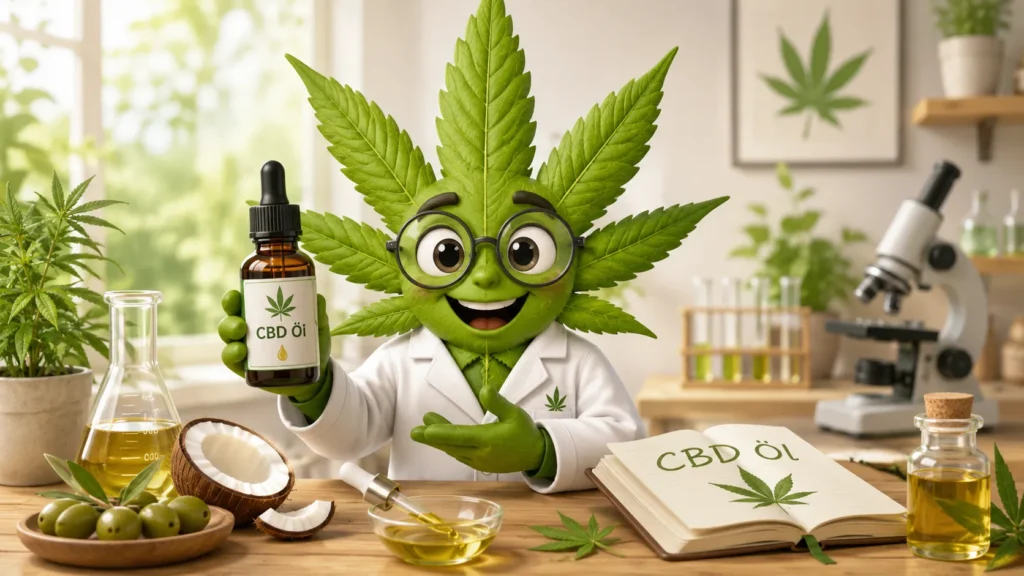
CBD oil is a liquid product that combines a CBD-containing ingredient with a carrier oil. Labels commonly show a percentage, milligrams, bottle size and terms such as full-spectrum, broad-spectrum or CBD isolate.
This page explains how CBD oil is structured, common carrier oils, the relationship between percentages and milligrams, and the main terms used on product labels.
- This guide: CBD oil structure, carrier oils, concentration, bottle size and product terminology.
- CBD basics: What Is CBD?
- CBD vs THC: differences, intoxication and THC-related claims.
- Cannabinoids: CBD, THC, CBG, CBN and cannabinoid profiles.
- Extract types: full-spectrum, broad-spectrum and CBD isolate.
- Laboratory results: COAs, batches, units and detection limits.
What Is CBD Oil?
CBD oil usually consists of a CBD-containing ingredient combined with a liquid carrier oil. CBD stands for cannabidiol, a cannabinoid found in cannabis. The carrier oil forms the liquid base of the finished product.
The name “CBD oil” does not describe the complete composition. Two bottles can show the same CBD concentration while differing in extract type, carrier oil, other ingredients, cannabinoid profile and total volume.
CBD is the individual compound. CBD oil is a finished liquid product. CBD percentage, extract type and carrier oil describe different characteristics of the same bottle.
What Is CBD Oil Made From?
The simplest formulation combines a CBD-containing ingredient with a carrier oil. Depending on the product, additional cannabinoids, terpenes, flavourings or other ingredients may also be present.
| Component | Role in the Product | Typical Description |
|---|---|---|
| CBD-containing ingredient | Provides cannabidiol and, depending on extract type, other plant compounds. | Full-spectrum, broad-spectrum or CBD isolate. |
| Carrier oil | Forms the liquid base. | Hemp seed oil, MCT oil or olive oil. |
| Other cannabinoids | May occur in broader extracts. | For example CBG, CBC, CBN or measurable THC. |
| Terpenes | Aromatic plant compounds that may occur naturally or be added. | Individual terpenes or a terpene profile. |
| Flavourings or additives | Change taste or formulation. | Listed in the ingredient information. |
The front of a bottle often shows only part of this information. The ingredient list, product description and relevant laboratory documentation provide a fuller picture.
CBD Oil, Hemp Seed Oil and Cannabis Oil Are Different Terms
These terms are often mixed together, but they do not automatically describe the same product.
| Term | Typical Meaning | Important Limitation |
|---|---|---|
| CBD oil | A CBD-containing ingredient combined with a carrier oil. | Composition and concentration can vary significantly. |
| Hemp seed oil | Plant oil produced from hemp seeds. | Does not automatically contain a meaningful amount of CBD. |
| Hemp oil | An imprecise term often used for hemp seed oil. | The ingredient list is needed to determine what the product contains. |
| Cannabis oil | An ambiguous term used for different oils and extracts. | Cannot be clearly classified without knowing the composition. |
Hemp seed oil can itself be used as the carrier oil in a CBD oil. In that case, the bottle contains hemp seed oil as the base plus a separate CBD-containing ingredient.
Which Carrier Oils Are Used in CBD Oil?
The carrier oil can affect taste, colour and consistency. It does not, however, determine the overall quality of the product by itself.
| Carrier Oil | Typical Characteristic | What the Label Should Identify |
|---|---|---|
| Hemp seed oil | Often has a nutty flavour and natural plant-oil colour. | Hemp seed oil as a specific ingredient. |
| MCT oil | Often relatively neutral in taste and clear to pale in colour. | MCT oil and, where provided, its source. |
| Olive oil | Has its own distinctive taste and typical plant-oil colour. | Olive oil as a specific ingredient. |
| Other plant oils | Characteristics depend on the oil used. | The specific oil rather than a vague term such as “premium oil”. |
The carrier oil should not be confused with the CBD extract. The oil forms the base of the liquid, while the CBD-containing ingredient provides cannabidiol.
CBD Strength: Percentage, mg/ml and Total CBD
CBD oils are often marketed using a percentage. To understand the amount of CBD in a bottle properly, the bottle volume and total CBD amount in milligrams are also important.
| Label Value | What It Describes | Example |
|---|---|---|
| Percentage | Product concentration. | 5%, 10% or 15% CBD. |
| mg/ml | Amount of CBD per millilitre of liquid. | 100 mg/ml. |
| Total CBD in mg | Amount of CBD in the whole bottle. | 1,000 mg CBD. |
| Bottle volume | Total amount of liquid. | 10 ml or 30 ml. |
With the common labeling convention used for many CBD oils, 1% corresponds approximately to 10 mg of CBD per millilitre. A 10 ml bottle labeled 5% is therefore commonly presented as containing about 500 mg of CBD. The explicit milligram amount stated by the manufacturer remains the better value to verify.
| Common Percentage | Approximate CBD per ml | Typical Total in a 10 ml Bottle |
|---|---|---|
| 5% | about 50 mg/ml | about 500 mg CBD |
| 10% | about 100 mg/ml | about 1,000 mg CBD |
| 15% | about 150 mg/ml | about 1,500 mg CBD |
| 20% | about 200 mg/ml | about 2,000 mg CBD |
Total CBD = CBD in mg/ml × bottle volume in ml. Example: 100 mg/ml × 10 ml = 1,000 mg CBD in the bottle.
Percentages can be rounded or defined differently by individual manufacturers. For that reason, an explicit milligram value on the label and product page is usually the better figure to cross-check.
What Does “mg per Drop” Mean?
Some manufacturers convert the CBD amount into an estimated amount per drop. This calculation depends on an assumed number of drops per millilitre or per bottle.
Actual drop size can vary with the dropper, temperature, oil viscosity and handling. “mg per drop” is therefore a product-specific manufacturer estimate rather than a universal fixed unit.
This guide does not use the figure to provide consumption or dosage advice. For comparing product concentration, mg/ml and total CBD in milligrams are generally more consistent reference points.
What Role Does the Extract Type Play?
CBD oil can be made using full-spectrum extract, broad-spectrum extract or CBD isolate. The extract type describes whether compounds other than CBD may also be present.
| Extract Type | Simple Description in CBD Oil |
|---|---|
| Full-spectrum | A broader plant-compound profile; THC may be relevant depending on the product and batch. |
| Broad-spectrum | A broader profile in which THC is generally intended to be reduced, removed or not detectable at the stated analytical limit. |
| CBD isolate | Highly purified cannabidiol without a broad natural cannabinoid profile. |
The extract category describes one aspect of the formulation, not an automatic quality ranking. A specific product should still be assessed using its composition and supporting documentation.
How to Read a CBD Oil Label
A useful CBD oil label separates concentration, bottle volume, ingredients and product identity. Each piece of information answers a different question.
| Label Information | What It Helps You Understand |
|---|---|
| Product name | How the manufacturer identifies the finished product. |
| CBD percentage | The marketed concentration. |
| CBD in milligrams | The amount stated per ml or for the full bottle. |
| Bottle volume | How much liquid the bottle contains. |
| Ingredient list | Which carrier oil and other ingredients are present. |
| Extract type | Whether the product uses full-spectrum, broad-spectrum or isolate. |
| Batch or lot number | Which production batch the bottle belongs to. |
| Best-before or expiry information | The manufacturer’s stated shelf-life information. |
| Responsible company | Which business is responsible for placing or supplying the product. |
Marketing terms such as “premium”, “extra strength” or “natural” do not replace these specific product details.
What Does a Certificate of Analysis Add?
A laboratory report or Certificate of Analysis can provide additional information about the tested sample. It may show measured CBD, THC and other cannabinoid values.
The basic rule is that the report should match the product and, where possible, the specific batch. Values such as CBD, CBDA, THC, THCA, ND, LOD and LOQ need to be interpreted together with units and analytical limits.
What Does “THC-Free” Mean on CBD Oil?
“THC-free” is a THC-related product claim. It may mean that THC was not detected using a particular analytical method. The wording alone does not explain the detection limit or confirm which batch was tested.
For the basic distinction between the compounds, see CBD vs THC. A batch-specific laboratory report is needed to understand a particular THC result properly.
CBD Oil Storage and Packaging
CBD oils are commonly supplied in dark glass bottles with a dropper. Packaging can help protect the contents and make the product easier to handle, but it does not replace the manufacturer’s storage instructions.
- Original container: keep the product in its intended packaging where practical.
- Closure: close the bottle properly after use.
- Light and heat: follow the manufacturer’s storage instructions.
- Shelf life: check the stated date and any instructions that apply after opening.
- Changes: if the smell, appearance or packaging changes unexpectedly, check the manufacturer’s guidance before using the product.
Common Misconceptions About CBD Oil
| Misconception | Better Explanation |
|---|---|
| CBD oil and hemp seed oil are the same thing. | Hemp seed oil can be a carrier oil but does not automatically contain a meaningful amount of CBD. |
| A high CBD percentage proves high quality. | The percentage describes concentration, not overall product quality. |
| 10% means the same total CBD in every bottle. | Total CBD also depends on bottle volume. |
| Every drop is exactly the same size. | Drop size can vary with the dropper, oil and handling. |
| Full-spectrum is automatically better. | Extract type describes composition, not a universal quality ranking. |
| “THC-free” explains the entire laboratory result. | The claim should be read together with the testing method, analytical limit and batch. |
Which CBD Wiki Topic Should You Read Next?
| Question | Next Topic | Main Focus |
|---|---|---|
| What is CBD? | What Is CBD? | Cannabidiol, hemp and common product forms. |
| How are CBD and THC different? | CBD vs THC | Intoxication, perception and compound differences. |
| What other cannabinoids exist? | Cannabinoids | CBD, THC, CBG, CBN and cannabinoid profiles. |
| How do extract types differ? | Full-Spectrum vs Broad-Spectrum vs CBD Isolate | Cannabinoid profile and THC content. |
| How do I read laboratory values? | CBD Certificate of Analysis | COAs, batches, units and detection limits. |
| How can CBD product quality be assessed? | CBD Quality | Labeling, composition and traceability. |
| Where does the English CBD knowledge base begin? | CBD Wiki | Central overview of SaveSleuth CBD guides. |
Official Information About CBD Products
For health, food-safety and legal questions, current information from relevant public authorities should generally be given more weight than marketing claims made on product pages. Which authority is relevant depends on the country and product category involved.
- EFSA: Cannabidiol and Novel Food safety assessment
- German BVL: Cannabidiol in foods and food supplements
- German BfR: Hemp-containing foods and potential health risks
CBD Oil in Simple Terms
CBD oil is a liquid product made from a CBD-containing ingredient and a carrier oil. Key product details include CBD concentration, total CBD amount, bottle volume, carrier oil, extract type and full ingredient list.
Percentages, milligrams and millilitres describe different measurements. Laboratory documentation can add useful information about a tested batch, while concentration alone does not establish overall product quality.
← Back to the CBD Wiki | What Is CBD? | CBD vs THC | Cannabinoids
Frequently Asked Questions About CBD Oil
What is CBD oil in simple terms?
CBD oil is usually a liquid mixture containing a CBD-containing ingredient and a carrier oil.
Is hemp seed oil the same as CBD oil?
No. Hemp seed oil is produced from hemp seeds and can be used as a carrier oil. CBD oil contains an additional CBD-containing ingredient.
What does 10% CBD oil mean?
Under the common labeling convention, 10% corresponds approximately to 100 mg of CBD per millilitre. A 10 ml bottle is therefore often labeled as containing about 1,000 mg of CBD. The manufacturer’s explicit milligram value should be checked.
Which carrier oils are commonly used for CBD oil?
Common carrier oils include hemp seed oil, MCT oil and olive oil. The specific carrier oil should be identified in the ingredient list.
Is CBD oil always full-spectrum?
No. CBD oil can be formulated using full-spectrum extract, broad-spectrum extract or CBD isolate.
Is CBD oil automatically THC-free?
No. THC content depends on the extract type, manufacturing process and individual batch. THC-related claims should be checked against suitable batch-specific laboratory documentation.