

CBD Certificate of Analysis (COA): How to Read Lab Results
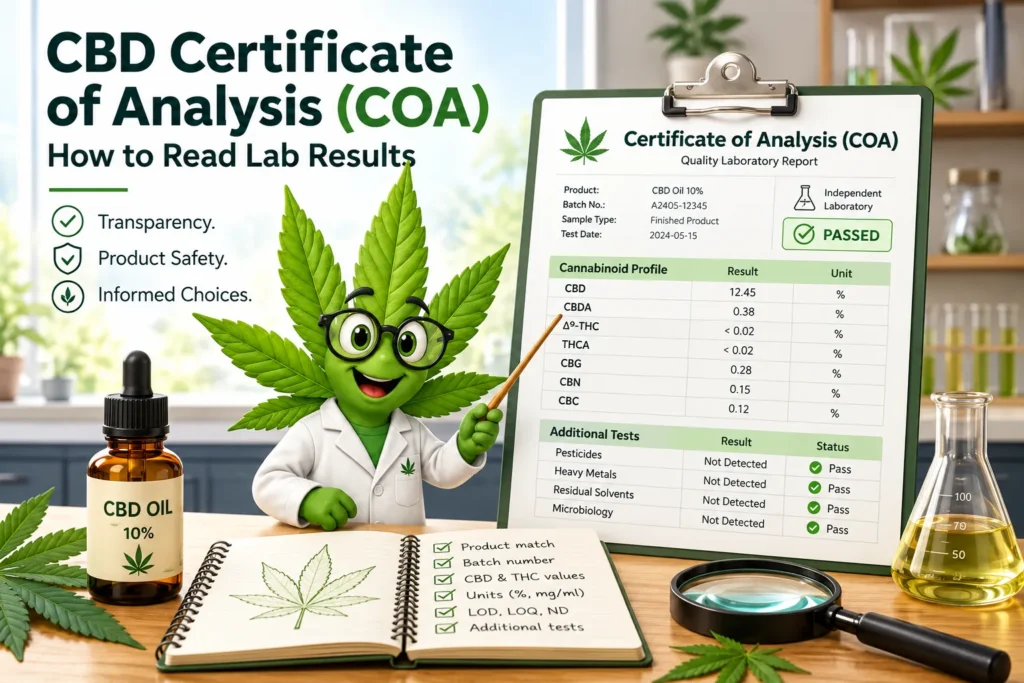
A CBD Certificate of Analysis, usually shortened to COA, is a laboratory report showing results measured in a particular sample. It may include cannabinoid values, batch information, units, analytical limits and additional testing panels.
This page explains how to read a CBD COA without treating a single number as proof of overall product quality. The first step is always to confirm that the report actually belongs to the product and batch being evaluated.
- This guide: COA fields, product matching, units, CBD and THC results, ND, LOD, LOQ and additional test panels.
- CBD basics: What Is CBD?
- CBD vs THC: compound differences and THC-related terminology.
- Cannabinoids: CBD, THC, CBG, CBN and acidic precursor forms.
- Extract types: full-spectrum, broad-spectrum and CBD isolate.
- Overall product quality: labeling, composition and traceability are assessed separately.
What Is a CBD Certificate of Analysis?
A CBD Certificate of Analysis is a laboratory report for a tested product or raw-material sample. The document records the results included in the requested analysis and usually identifies the units, sample details and laboratory information.
A COA describes the sample that was actually tested. It does not automatically prove that every other batch is identical, that every possible contaminant was tested or that the finished product satisfies every legal or quality requirement.
| Term | Meaning | Practical Interpretation |
|---|---|---|
| Certificate of Analysis | Laboratory report for a tested sample. | Shows the results included in that specific document. |
| COA | Abbreviation for Certificate of Analysis. | The term commonly used by CBD manufacturers and retailers. |
| Lab report | General term for analytical documentation. | May be supplied as a PDF, webpage, download or QR-code link. |
| Test report | Documentation of a particular laboratory analysis. | The scope depends on which tests were actually ordered. |
First Match the COA to the Product and Batch
Before reading cannabinoid percentages or contaminant results, confirm that the document belongs to the product in front of you. Product name, variant, strength, bottle size and batch or lot number should agree with the packaging or product page.
| COA Detail | What to Check | Possible Red Flag |
|---|---|---|
| Product or sample name | Does the description match the actual product? | Only a generic raw-material name with no clear product connection. |
| Batch or lot number | Does it match the number on the product? | No batch number or a different number. |
| Strength and variant | Do percentage, size and product version match? | A 5% report is shown for a product labeled 10%. |
| Test date | Can the report reasonably be linked to the batch? | An old sample report is reused for current stock. |
| Laboratory and report ID | Are the laboratory name and report reference visible? | An anonymous graphic with no traceable source. |
A technically detailed COA is of limited value if it cannot be clearly matched to the product. Check the product name, variant and batch before interpreting individual numbers.
How a CBD COA Table Is Usually Structured
Laboratory formats differ, but cannabinoid and contaminant reports often contain fields for the analyte, reported result, unit, detection or quantification limit and sometimes a status such as “Pass” or “Fail”.
| Typical Field | What It Means | What to Look For |
|---|---|---|
| Analyte or parameter | The compound or test item being measured. | Which cannabinoids or contaminants were actually included. |
| Result | The measured or reported value. | Always read it together with the unit and analytical limit. |
| Unit | The reference basis used for the result. | %, mg/g, mg/ml and mg per unit are not interchangeable. |
| LOD | Limit of Detection. | Below this level, the method cannot reliably detect the compound. |
| LOQ | Limit of Quantification. | Below this level, the amount cannot be quantified with the stated reliability. |
| ND | Not Detected. | Does not necessarily mean absolute zero. |
| Pass or Fail | Assessment against a criterion used in the report. | Check which specification or limit was applied. |
How to Compare CBD Results and Units
A CBD result only makes sense together with its unit. Two reports can describe the same cannabinoid using different reference bases, so numbers should not be compared without checking what each one represents.
| Unit | Typical Meaning | What to Check |
|---|---|---|
| % | Concentration relative to the laboratory’s stated calculation basis. | Check what the percentage refers to. |
| mg/g | Milligrams per gram of sample. | Common for solid or mass-based samples. |
| mg/ml | Milligrams per millilitre. | Common for liquid products such as oils. |
| mg per unit | Amount per capsule, gummy or another unit. | Check whether the value was directly measured or calculated. |
Conversion is only meaningful when the necessary reference data are known. Percentage, mg/g and mg/ml should therefore not be treated as equivalent figures without context.
For oil-specific concentration examples, see CBD Oil.
CBD, CBDA and Total CBD Are Different Values
A COA may report CBD and its acidic precursor CBDA separately. Some reports also provide a calculated total CBD figure based on a formula used by the laboratory or analytical method.
When comparing a COA with a product label, check whether the manufacturer is referring to neutral CBD, total CBD or another calculation. Values taken from different rows or calculated using different methods are not automatically directly comparable.
How to Read THC, THCA and Total THC
THC can also appear in more than one form. A report may list delta-9 THC, THCA and sometimes a calculated total THC value. The relevant question is which laboratory result actually supports the claim being made about the product.
Terms such as “THC-free”, “not detected” and “below the detection limit” are not automatically equivalent. A result should be interpreted together with the stated unit, LOD and LOQ.
For the underlying difference between the compounds, see CBD vs THC. Legal interpretation depends on the jurisdiction and product category and cannot be determined from a laboratory number alone.
ND, LOD and LOQ Explained
These abbreviations become especially important when a compound is absent from the reported result or present only at a very low level. Without the analytical limits, phrases such as “not detected” can be misleading.
- ND: the compound was not detected under the conditions of the test.
- LOD: below the Limit of Detection, the method cannot reliably detect the compound.
- LOQ: below the Limit of Quantification, the method cannot report a sufficiently reliable numerical amount.
- <LOD or <LOQ: the result falls below the stated analytical limit.
An ND result is therefore not universal proof that absolutely none of the compound exists. It reports what the particular analytical method found within its stated limits.
Other Cannabinoids in a COA
Besides CBD and THC, a laboratory report may list cannabinoids such as CBG, CBN, CBC, CBDA or THCA. Whether these values are relevant depends on the product description and the claim being checked.
| Cannabinoid | Name | Useful COA Question |
|---|---|---|
| CBD | Cannabidiol | Does the reported value match the product claim? |
| CBDA | Cannabidiolic acid | Is it reported separately or included in a calculated total? |
| THC | Tetrahydrocannabinol | Which form, unit and analytical limits are shown? |
| THCA | Tetrahydrocannabinolic acid | Is it separate or included in a total THC figure? |
| CBG | Cannabigerol | Does the measured value support a specific product claim? |
| CBN | Cannabinol | Is a result reported or is the compound only listed in the panel? |
| CBC | Cannabichromene | Is the result shown with a unit and analytical limit? |
The wider cannabinoid family is explained in Cannabinoids. For the distinction between different extract profiles, see Full-Spectrum vs Broad-Spectrum vs CBD Isolate.
Cannabinoid Testing Is Not the Same as Contaminant Testing
A cannabinoid profile does not automatically mean that the sample was tested for pesticides, heavy metals, solvents or microorganisms. Some COAs include several testing panels; others show cannabinoids only.
| Testing Area | What the Report May Show | What to Check |
|---|---|---|
| Pesticides | Results for the pesticide compounds included in the panel. | Which substances were actually tested. |
| Heavy metals | Measured values for listed metals. | Result, unit and applicable limit for each metal. |
| Residual solvents | Results for selected solvent residues. | Which solvents were included in the analysis. |
| Microbiology | Results for listed microbial parameters. | Which organisms or total-count measures were tested. |
| Mycotoxins | Results for specified fungal toxins. | Which compounds and limits are included. |
If a testing area is missing, the safest conclusion is simply that it is not shown in that document. A cannabinoid-only COA should not be described as comprehensive contaminant testing.
How to Compare Product Claims With the COA
| Product Claim | Relevant COA Check | Possible Problem |
|---|---|---|
| “10% CBD” | Check the CBD result, unit and calculation basis. | The report shows a different strength or an unrelated total value. |
| “THC-free” | Read the THC rows together with LOD and LOQ. | THC is absent from the report or only a vague graphic is shown. |
| “Full-spectrum” | Compare the cannabinoid profile with the product description. | Only CBD is shown and broader profile information is missing. |
| “Contains CBG” | Look for the CBG result and its unit. | CBG appears in marketing copy but not in the laboratory results. |
| “Comprehensively lab tested” | List the testing panels actually included. | The document contains only a cannabinoid profile. |
Common Red Flags in CBD Lab Reports
- The product name, variant or strength does not match the product page.
- The batch or lot number is missing or differs from the packaging.
- The test date, laboratory name or report number cannot be identified.
- Results appear without units or analytical limits.
- A small promotional graphic is provided instead of the full report.
- THC-related marketing claims cannot be traced to the COA.
- The same old sample report is used for several different strengths or products.
- The advertised testing scope is broader than the panels actually shown.
How to Read a CBD COA Step by Step
- Match the document. Compare product, variant, strength and batch.
- Check report details. Find the laboratory, report number and test date.
- Read the units. Distinguish %, mg/g, mg/ml and mg per unit.
- Review CBD rows. Check CBD, CBDA and any calculated total values separately.
- Review THC rows. Check THC, THCA, total values, LOD and LOQ.
- Check other cannabinoid claims. Do statements about CBG, CBN or other compounds match the measured results?
- Identify the testing scope. Do not confuse cannabinoid testing with pesticides, metals, solvents or microbiology.
- Investigate contradictions. Product labels, marketing claims and laboratory documentation should tell a consistent story.
What a CBD Certificate of Analysis Does Not Prove
A COA reports results for a tested sample within the scope of the listed analysis. It does not prove a medical effect, individual suitability or automatic legal compliance.
Even a detailed report does not replace checking the product identity, ingredient list, labeling and responsible company. A COA is one important part of product documentation rather than a complete quality verdict.
This page explains how laboratory documentation is structured and interpreted. It does not recommend a CBD dosage, method of use or medical application.
Which CBD Wiki Topic Should You Read Next?
| Question | Next Topic | Main Focus |
|---|---|---|
| What is CBD? | What Is CBD? | Cannabidiol, hemp and common product terminology. |
| How are CBD and THC different? | CBD vs THC | Compound differences and THC-related claims. |
| What are CBD, CBG, CBN and acidic cannabinoids? | Cannabinoids | Cannabinoid names, profiles and precursor forms. |
| How do full-spectrum, broad-spectrum and isolate differ? | CBD Extract Types | Cannabinoid profiles and THC context. |
| How are percentages and mg/ml used in CBD oil? | CBD Oil | Strength, carrier oils and product labels. |
| How can I assess overall product documentation? | CBD Quality | Product identity, labeling, composition and traceability. |
| Where does the full English knowledge base begin? | CBD Wiki | Central overview of SaveSleuth CBD guides. |
Official Information About CBD Products
For broader health, food-safety or legal questions, current information from relevant public authorities should generally be given more weight than marketing claims. The appropriate authority depends on the country and product category involved.
- EFSA: Cannabidiol and Novel Food safety assessment
- German BVL: Cannabidiol in foods and food supplements
- German BfR: Hemp-containing foods and potential health risks
CBD COAs in Simple Terms
A CBD COA should first be matched to the correct product and batch. After that, check the laboratory, report date, units, CBD and THC rows, detection limits and the actual scope of testing.
A number on its own is rarely enough. A laboratory result becomes meaningful when it is read together with the analyte name, unit, LOD, LOQ and product identity. A COA is valuable evidence, but it remains only one part of a wider product-quality assessment.
← Back to the CBD Wiki | CBD vs THC | Cannabinoids | CBD Oil | CBD Extract Types
Frequently Asked Questions About CBD Certificates of Analysis
What does COA mean for CBD?
COA stands for Certificate of Analysis. It is a laboratory report documenting results from a tested sample.
How can I tell whether a COA belongs to a CBD product?
Compare the product name, variant, strength, bottle or pack size and batch number with the product and packaging. The test date and report number can also help confirm the connection.
What does ND mean on a CBD lab report?
ND usually means “Not Detected”. It means the compound was not detected under the conditions and analytical limits of the test.
What is the difference between LOD and LOQ?
LOD is the Limit of Detection, while LOQ is the Limit of Quantification. Below the LOD a compound cannot be reliably detected; below the LOQ its amount cannot be quantified with the stated reliability.
Why can CBD results look different between lab reports?
Laboratories may report results as percentages, mg/g, mg/ml or amounts per unit. CBD, CBDA and calculated total values may also appear separately, so units and calculation methods need to be checked.
Does every CBD COA test for pesticides and heavy metals?
No. Some reports contain only a cannabinoid profile. Pesticide, heavy-metal, solvent, microbiological or other contaminant testing should appear as separate testing sections if they were included.