

CBD vs THC: What’s the Difference?
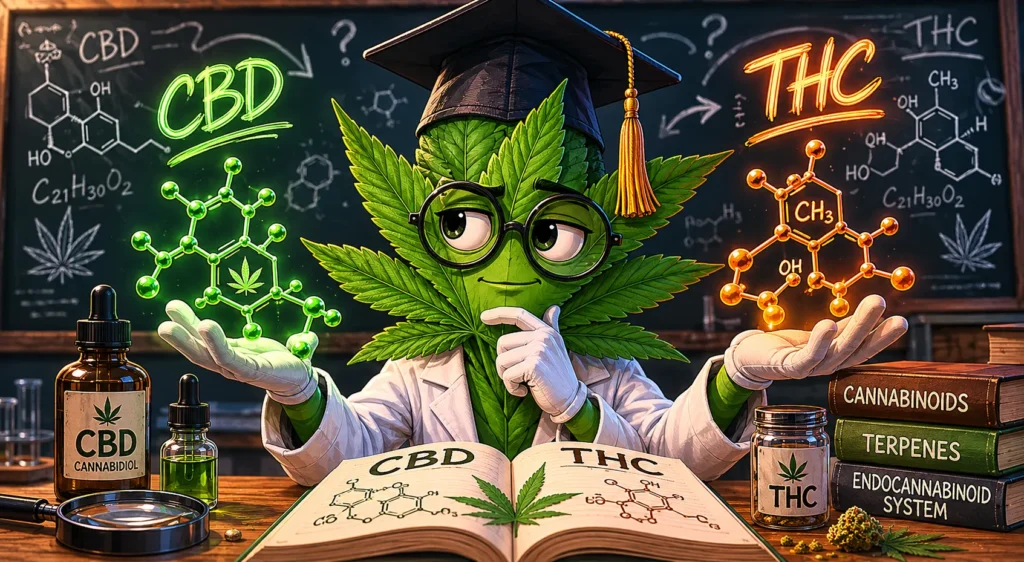
CBD and THC are both cannabinoids found in cannabis, but they are not the same compound. THC is best known for its intoxicating effects. CBD is not associated with the typical THC high.
This page explains the main differences in intoxication, perception, product composition and everyday use. Detailed legal questions, laboratory values and product-quality checks are covered separately.
- This guide: the basic difference between CBD and THC, intoxication, perception and common product claims.
- CBD basics: What Is CBD?
- Lab results: COAs, CBD, THC, detection limits and batch-specific testing.
- Extract types: full-spectrum, broad-spectrum and CBD isolate.
- Legal context: depends on product type, intended use and jurisdiction.
- Product quality: composition, labeling, batch information and documentation.
CBD vs THC at a Glance
CBD stands for cannabidiol, while THC stands for tetrahydrocannabinol. Both belong to the cannabinoid family. The most important practical difference is that THC can produce intoxicating effects, while CBD does not produce the typical THC high.
| Feature | CBD | THC |
|---|---|---|
| Full name | Cannabidiol | Tetrahydrocannabinol |
| Compound group | Cannabinoid | Cannabinoid |
| Typical classification | Not associated with the classic cannabis high. | Associated with intoxicating effects. |
| Perception | Does not produce the THC-typical changes in perception. | Can affect perception, reaction time and judgement. |
| Relevant in CBD products? | Often the main marketed cannabinoid. | May appear as a trace or measurable value depending on the product and extract type. |
| Useful next topic | What Is CBD? | CBD laboratory reports and COAs |
What Is CBD?
CBD is short for cannabidiol. It occurs naturally in Cannabis sativa L. and can be used in different hemp- and CBD-related products.
CBD is not associated with the typical THC high. That does not mean that every product carrying the word “CBD” has the same composition, documentation or intended use.
The full definition, origin and common product forms are covered in What Is CBD?. On this page, CBD is considered specifically in comparison with THC.
What Is THC?
THC is short for tetrahydrocannabinol. In everyday use, the term usually refers to delta-9 THC, the cannabinoid most strongly associated with the intoxicating effects of cannabis.
THC can affect perception, reaction time and judgement. This is why it is treated differently from CBD in areas such as product labeling, safety, driving and legal classification.
This guide does not provide universal legal thresholds. Rules can vary by jurisdiction, product category and intended use, so legal questions should always be checked against the relevant local framework.
Does CBD Get You High?
CBD does not produce the typical THC high. The simple answer to “Does CBD get you high?” is therefore that CBD is not classified in the same way as THC when it comes to intoxication.
A finished CBD product should still be assessed as a complete formulation rather than by the word CBD alone. Depending on the extract type, other cannabinoids may be present. Incorrect labeling or an unsuitable laboratory report can also make a product harder to evaluate.
CBD is not THC. But a CBD product is more than the name of one compound. Extract type, full composition and batch-specific documentation still matter.
Why CBD and THC Are Often Confused
Both compounds occur in cannabis and are often discussed together in articles about hemp, cannabis and cannabinoids. This can create the impression that CBD and THC are interchangeable terms.
Product terminology can add to the confusion. Labels such as hemp oil, CBD oil, cannabis oil or hemp extract are not always used consistently. A product name alone therefore does not tell you which cannabinoids are actually present.
| Term on the Product | What It Tells You | What Still Needs to Be Checked |
|---|---|---|
| CBD oil | The product is marketed as containing CBD. | CBD amount, extract type, other ingredients and THC information. |
| Hemp oil | The product has some connection to hemp. | Whether it contains CBD or THC at all. |
| Full-spectrum | A broader plant-compound profile is being claimed. | Actual cannabinoid profile and measured THC value. |
| THC-free | The manufacturer claims that THC is absent or not detected. | Testing method, detection limit and batch-specific COA. |
CBD and THC Do Not Act in the Same Way
CBD and THC are different chemical compounds and do not interact with the body in identical ways. For a general consumer comparison, the practical distinction matters more than an oversimplified biochemical explanation: THC can produce intoxication, while CBD does not produce the typical THC high.
A detailed medical explanation of effects is outside the scope of this page. Effects, tolerability and possible interactions depend on multiple factors and should be discussed with qualified professionals when individual health questions are involved.
“Psychoactive” and “Intoxicating” Are Not Always the Same Thing
In everyday language, THC is often described as psychoactive while CBD is described as non-psychoactive. That shorthand can be misleading because the term “psychoactive” is used differently across scientific and everyday contexts.
For a clear consumer explanation, “intoxicating” is more useful: THC can produce a cannabis high, while CBD is not associated with that typical THC intoxication.
Can a CBD Product Contain THC?
Yes. CBD and THC are different compounds, but both can occur in the same plant extract. Whether a finished CBD product contains THC depends on factors such as the starting material, extract type, processing method and individual batch.
Full-spectrum products may contain a broader cannabinoid profile. Broad-spectrum products are often marketed as having no detectable THC. CBD isolate is intended to contain highly purified cannabidiol. These terms alone, however, do not replace a suitable laboratory report.
What Does “THC-Free” Mean?
“THC-free” sounds absolute, but the claim can mean different things in product descriptions. In some cases, a manufacturer may mean that THC was not detected using a particular analytical method. In others, the claim may refer to a specific testing or regulatory threshold.
The claim should therefore be checked against the laboratory report for the relevant batch. THC entries, units, results and detection or quantification limits all matter.
Terms such as ND, LOD and LOQ are especially important when interpreting claims that a cannabinoid is absent or not detectable.
CBD, THC, CBDA and THCA Are Different Compounds
Laboratory reports may list CBDA and THCA alongside CBD and THC. These are related compounds, but they are not identical. A COA may show individual values as well as calculated total values.
For this basic comparison, the important distinction is simple: CBD is not THC, CBDA is not CBD and THCA is not the same thing as delta-9 THC. Detailed interpretation of laboratory rows and units belongs in the dedicated COA guide.
CBD vs THC in Everyday Situations
The difference between CBD and THC is not only theoretical. It can affect how a product is described, tested and assessed in everyday situations.
| Everyday Question | CBD | THC |
|---|---|---|
| Intoxication | Not associated with the typical cannabis high. | Can produce intoxicating effects. |
| Reaction and judgement | Not classified in the same way as THC, but the complete product still matters. | Can impair reaction time and judgement. |
| Product assessment | Check CBD amount, extract type and composition. | Check THC value and its relevance to the product particularly carefully. |
| Laboratory report | Distinguish CBD, CBDA and possible calculated totals. | Distinguish THC, THCA, total values and detection limits. |
| Legal status | Depends on the specific product and jurisdiction. | Also depends on the product and applicable rules. |
Common Misconceptions About CBD and THC
| Misconception | Better Explanation |
|---|---|
| CBD and THC are the same thing. | They are different cannabinoids. |
| CBD gets you high just like THC. | CBD does not produce the typical THC high. |
| Every CBD product is automatically THC-free. | Depending on the extract type and batch, THC may still be relevant. |
| “THC-free” always means absolute zero. | The claim should be read together with the test method and detection limit. |
| Full-spectrum is automatically better. | Extract type is a product characteristic, not a universal quality seal. |
| A CBD label is enough to verify a product. | The label, composition and batch-specific documentation should agree with each other. |
Which CBD Wiki Topic Should You Read Next?
| Question | Next Topic | Main Focus |
|---|---|---|
| What is CBD? | What Is CBD? | Definition, origin and common product forms. |
| How do I read CBD and THC values? | CBD Certificate of Analysis | COAs, units, LOD, LOQ, CBD, CBDA, THC and THCA. |
| How do extract types differ? | Full-Spectrum vs Broad-Spectrum vs CBD Isolate | Cannabinoid profile and THC content. |
| How can product quality be assessed? | CBD Quality | Product identity, batch, labeling and documentation. |
| How is CBD regulated? | Country-Specific CBD Legal Guides | Product category, intended use and local legal rules. |
| Where does the English CBD knowledge base begin? | CBD Wiki | Central hub for CBD science, quality, safety and product knowledge. |
Official Information About CBD and THC
For health, food-safety or legal questions, current information from public authorities should generally be given more weight than short product descriptions or marketing claims. The most relevant authority will depend on the country and product category involved.
- German BfR: Hemp-containing foods and potential health risks
- German BVL: Cannabidiol in foods and food supplements
- EFSA: Cannabidiol and Novel Food safety assessment
CBD vs THC: The Simple Summary
CBD and THC are different cannabinoids. THC can produce intoxication and can affect perception, reaction time and judgement. CBD is not associated with this typical THC high.
THC can still matter when evaluating a finished CBD product because some extracts may contain other cannabinoids. Claims such as “THC-free” should therefore be assessed together with suitable batch-specific laboratory documentation.
← Back to the CBD Wiki | What Is CBD?
Frequently Asked Questions About CBD and THC
What is the main difference between CBD and THC?
THC can produce intoxicating effects. CBD is not associated with the typical THC high. Both compounds nevertheless belong to the cannabinoid family.
Does CBD get you high?
CBD does not produce the typical THC high. For a finished product, the extract type, overall composition and THC information should still be checked.
Can a CBD product contain THC?
Yes. Depending on the starting material, extract type, processing and batch, a CBD product may also contain THC. A batch-specific COA can help clarify the cannabinoid profile.
Is CBD always THC-free?
No. CBD as an individual compound is not THC, but a finished CBD product may contain additional cannabinoids depending on how it was made.
What does “THC-free” mean?
The claim may mean that THC was not detected using a particular analytical method. The relevant COA, detection limit and connection to the specific product batch should be checked.
Are CBD and THC both psychoactive?
The word “psychoactive” is used in different ways. For consumers, the clearer distinction is that THC can produce intoxication, while CBD does not produce the typical THC high.