

Full-Spectrum vs Broad-Spectrum vs CBD Isolate
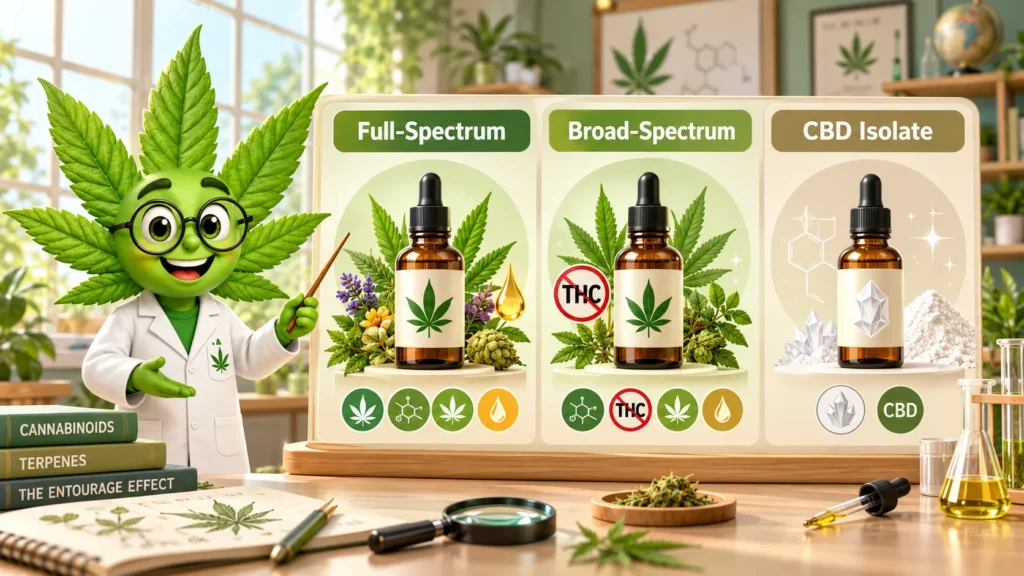
Full-spectrum, broad-spectrum and CBD isolate describe different types of CBD ingredients. The main difference is how broad the cannabinoid and plant-compound profile is intended to be.
This page explains the three extract types, their typical characteristics and the limits of these labels. THC values, laboratory reports, product quality and legal classification need to be assessed separately.
- This guide: differences between full-spectrum, broad-spectrum and CBD isolate.
- CBD basics: What Is CBD?
- CBD and THC: compound differences, intoxication and THC-related claims.
- Cannabinoids: CBD, THC, CBG, CBN and cannabinoid profiles.
- CBD oil: strength, carrier oils and product labels.
- Laboratory results: COAs, batches, units, ND, LOD and LOQ are covered separately.
Full-Spectrum, Broad-Spectrum and Isolate at a Glance
The word “spectrum” is used to describe, in simplified terms, whether compounds other than CBD may remain in a hemp-derived ingredient. It does not by itself establish product quality, effectiveness or legal status.
| Extract Type | Typical Profile | THC Context | Important Limitation |
|---|---|---|---|
| Full-spectrum | CBD plus other cannabinoids and potentially other plant compounds. | THC may be present depending on the product and batch. | The term alone does not prove which compounds or amounts are present. |
| Broad-spectrum | CBD plus other compounds, while THC is intended to be reduced, removed or not detectable. | Any THC-related claim should match suitable laboratory documentation. | “Broad-spectrum” is not used identically by every manufacturer. |
| CBD isolate | Highly purified CBD as the main cannabinoid ingredient. | THC is not normally expected in pure CBD isolate. | The finished product can still contain other added ingredients. |
Full-spectrum means a broader profile, broad-spectrum usually means a broader profile with THC reduced or not detected, and isolate means highly purified CBD. The actual composition still has to be confirmed from the product documentation.
What Does “Spectrum” Mean in CBD Products?
“Spectrum” is a market term referring to the breadth of the plant-compound profile. It mainly indicates whether cannabinoids other than CBD, and potentially other hemp-derived compounds, are intended to remain in the ingredient.
The term does not describe the finished product category. An oil, capsule, cosmetic or other formulation may use full-spectrum extract, broad-spectrum extract or CBD isolate.
CBD concentration is also a separate characteristic. A product labeled 10% CBD could be full-spectrum, broad-spectrum or isolate-based. Concentration answers how much CBD is stated; extract type describes the intended composition of the CBD ingredient.
What Is Full-Spectrum CBD?
Full-spectrum CBD usually refers to a hemp-derived extract in which compounds other than CBD may remain. These can include other cannabinoids, terpenes and additional plant compounds.
Full-spectrum does not mean that every product has the same profile. Starting material, processing, formulation and individual batch can all affect which compounds are actually present.
- Broader cannabinoid profile: cannabinoids other than CBD may be present.
- THC may be relevant: measurable or very low amounts of THC can occur depending on the product.
- Not a quality guarantee: “full-spectrum” is not a certification or quality seal.
- Documentation still matters: product claims should agree with the cannabinoid profile and relevant batch information.
For the underlying difference between the two best-known cannabinoids, see CBD vs THC. The wider cannabinoid family is explained in Cannabinoids.
What Is Broad-Spectrum CBD?
Broad-spectrum CBD is generally intended to contain several hemp-derived compounds while THC has been reduced, removed or is not detected using the stated analytical method.
Broad-spectrum is not a single standardized recipe used identically across the market. Two products with the same label can have different cannabinoid profiles, so the term should be read together with the actual composition and laboratory information.
- More than CBD alone: additional cannabinoids or plant compounds may remain.
- Check the THC claim: “THC-free”, “ND” and “below the limit of quantification” do not necessarily mean exactly the same thing.
- Profiles vary: the label does not define a fixed list of cannabinoids.
- Batch evidence matters: a laboratory report should match the product and, where possible, the relevant batch.
What Is CBD Isolate?
CBD isolate is highly purified cannabidiol. Unlike full-spectrum and broad-spectrum ingredients, it is centered on CBD as the main cannabinoid rather than preserving a broad natural plant-compound profile.
Isolate can exist as a powder or crystalline raw material, or it can be incorporated into CBD oil, capsules, cosmetics or other formulations. A finished isolate-based product may therefore contain carrier oils, flavourings or other added ingredients.
- CBD as the main cannabinoid: the raw ingredient is predominantly cannabidiol.
- No broad natural cannabinoid profile: other naturally occurring cannabinoids are not normally expected in the isolate itself.
- Not automatically lower quality: isolate is a different ingredient type, not a negative quality grade.
- Check the finished formulation: CBD isolate and the finished consumer product are not the same thing.
Full-Spectrum vs Broad-Spectrum vs CBD Isolate
| Characteristic | Full-Spectrum | Broad-Spectrum | CBD Isolate |
|---|---|---|---|
| CBD | Present | Present | Main cannabinoid |
| Other cannabinoids | Typically possible | Typically possible | Normally not part of the isolate itself |
| THC | May be present depending on product and batch | Usually intended to be removed, reduced or not detectable | Normally not expected in pure isolate |
| Terpenes and other plant compounds | May be present | May be present | Normally not part of the isolate itself |
| Single universal market definition | No | No | Term is generally clearer, but purity still needs verification |
| Laboratory documentation useful | Yes | Yes | Yes |
These Terms Are Not Quality Grades
Full-spectrum is not automatically better than broad-spectrum, and broad-spectrum is not automatically better than isolate. The three terms describe different types of ingredient profiles rather than a ranking from best to worst.
Other factors matter when assessing a finished product: clear product identity, understandable composition, batch-specific documentation, accurate labeling and an identifiable responsible company.
A well-documented isolate-based product can be more transparent than a full-spectrum product with unclear composition. Extract type by itself does not determine overall quality.
Why the Same Label Does Not Always Mean the Same Profile
Manufacturers do not always use these terms for identical formulations. One full-spectrum product can have a very different cannabinoid profile from another product carrying the same description. The same is true for broad-spectrum products.
A manufacturer may also purify an ingredient and later add selected terpenes or other compounds back into the formulation. The front-label term therefore does not explain every step of production or the exact finished composition.
| Label | What It Suggests | What Still Needs Checking |
|---|---|---|
| Full-spectrum | A broader compound profile is claimed. | Which compounds and amounts are actually present. |
| Broad-spectrum | A broader profile with THC reduced or not detected is claimed. | Which compounds remain and what the THC result actually shows. |
| CBD isolate | Highly purified CBD is used. | Which additional ingredients are present in the finished product. |
| “THC-free” | The manufacturer is making a THC-related claim. | Testing method, analytical limit and relevant batch. |
How to Identify the Extract Type on a Product
The extract type may be stated on the front label, ingredient list, product description or laboratory documentation. The important point is that these sources should not contradict one another.
- Read the product name. Does it say full-spectrum, broad-spectrum or CBD isolate?
- Check the ingredients. Is hemp extract, CBD isolate or another CBD-containing ingredient identified?
- Compare the description. Does the claimed cannabinoid profile make sense alongside the listed ingredients?
- Check the laboratory report. Does it belong to the correct product variant and batch?
- Investigate contradictions. If the label and documentation disagree, the manufacturer or seller should be able to explain which ingredient type is actually used.
Extract Type and Product Type Are Different Things
Full-spectrum, broad-spectrum and isolate describe the CBD ingredient or extract profile. Oil, capsule, gummy, cream or another format describes the form of the finished product.
| Level | Examples | Main Question |
|---|---|---|
| Extract type | Full-spectrum, broad-spectrum, CBD isolate | How broad is the cannabinoid and plant-compound profile? |
| Product form | Oil, capsule, gummy, cream | What form does the finished product take? |
| Concentration | Percentage, mg/ml, mg per unit | How much CBD is stated? |
| Product category or intended use | Food, cosmetic or other marketed category | How is the finished product presented and classified? |
For oil-specific terminology such as percentages, milligrams, bottle volume and carrier oils, see CBD Oil.
Which CBD Extract Type Is Best?
There is no universally best extract type. The most suitable option depends on the desired ingredient profile, how clearly the individual product is documented and any THC-related requirements that matter in the relevant context.
A decision should therefore not be based only on phrases such as “premium full-spectrum” or “pure isolate”. The label should agree with the composition and supporting documentation.
| Priority | Extract Type Often Considered | What Still Needs Checking |
|---|---|---|
| Broader cannabinoid profile | Full-spectrum or broad-spectrum | Actual cannabinoid profile and THC result. |
| CBD as the main individual cannabinoid | CBD isolate | Purity and the composition of the finished product. |
| THC should not be detectable | Broad-spectrum or isolate products are often marketed this way | Batch-specific laboratory result and analytical limit. |
| Simple ingredient profile | Often isolate-based | Other ingredients in the finished formulation. |
No row in this table is a recommendation to use or consume a specific CBD product. It shows only how the terminology is commonly used when comparing formulations.
Common Misconceptions About CBD Extract Types
| Misconception | Better Explanation |
|---|---|
| Full-spectrum is always the highest-quality option. | Full-spectrum describes a broader profile, not guaranteed product quality. |
| Broad-spectrum is automatically completely THC-free. | Any THC claim needs to be interpreted with the testing method and relevant laboratory result. |
| CBD isolate is always lower quality. | Isolate is a different CBD ingredient type and can be documented very clearly. |
| A high CBD percentage tells you the spectrum type. | Concentration and extract type are separate characteristics. |
| All full-spectrum products have the same profile. | Composition can vary by starting material, processing and batch. |
| The product name is enough to identify the extract. | Product description, ingredients and laboratory documentation should agree. |
Which CBD Wiki Topic Should You Read Next?
| Question | Next Topic | Main Focus |
|---|---|---|
| What is CBD? | What Is CBD? | Cannabidiol, hemp and CBD basics. |
| How are CBD and THC different? | CBD vs THC | Compound differences, intoxication and THC-related claims. |
| What other cannabinoids may appear? | Cannabinoids | CBD, THC, CBG, CBN and cannabinoid profiles. |
| How do these extract types appear in CBD oil? | CBD Oil | Carrier oils, concentration, labels and extract terminology. |
| How do I read CBD and THC laboratory values? | CBD Certificate of Analysis | COA, batch, units, ND, LOD and LOQ. |
| How can I assess CBD product documentation? | CBD Quality | Product identity, labeling, composition and traceability. |
| Where does the full knowledge base begin? | CBD Wiki | Central overview of SaveSleuth CBD guides. |
Full-Spectrum, Broad-Spectrum and Isolate in Simple Terms
Full-spectrum generally refers to a broader hemp-derived compound profile in which cannabinoids other than CBD may remain. Broad-spectrum usually refers to a broader profile in which THC has been reduced, removed or is not detected at the stated analytical limit. CBD isolate is highly purified cannabidiol without a broad natural cannabinoid profile.
None of the three forms is automatically better. The useful question is whether the product name, ingredients, cannabinoid profile and supporting documentation tell the same story.
← Back to the CBD Wiki | What Is CBD? | CBD vs THC | Cannabinoids | CBD Oil
Frequently Asked Questions About Full-Spectrum, Broad-Spectrum and CBD Isolate
What is full-spectrum CBD?
Full-spectrum CBD usually refers to a hemp-derived extract in which CBD is present together with other cannabinoids and potentially other naturally occurring plant compounds.
What is broad-spectrum CBD?
Broad-spectrum CBD generally contains CBD together with other hemp-derived compounds while THC is intended to be reduced, removed or not detected using the stated analytical method.
What is CBD isolate?
CBD isolate is highly purified cannabidiol. It normally does not contain the broad natural cannabinoid and plant-compound profile associated with full-spectrum extracts.
Is full-spectrum CBD better than CBD isolate?
Not automatically. They are different ingredient types. Product quality, composition and supporting documentation are more useful criteria than treating the spectrum labels as a simple ranking.
Is broad-spectrum CBD always THC-free?
The label alone is not enough to establish that. The relevant batch laboratory report, testing method and analytical detection or quantification limits should be considered.
Can CBD oil be made with CBD isolate?
Yes. CBD isolate can be combined with a carrier oil and other ingredients to create a finished CBD oil. Extract type and finished product form are separate characteristics.