

What Is CBD? Cannabidiol Explained
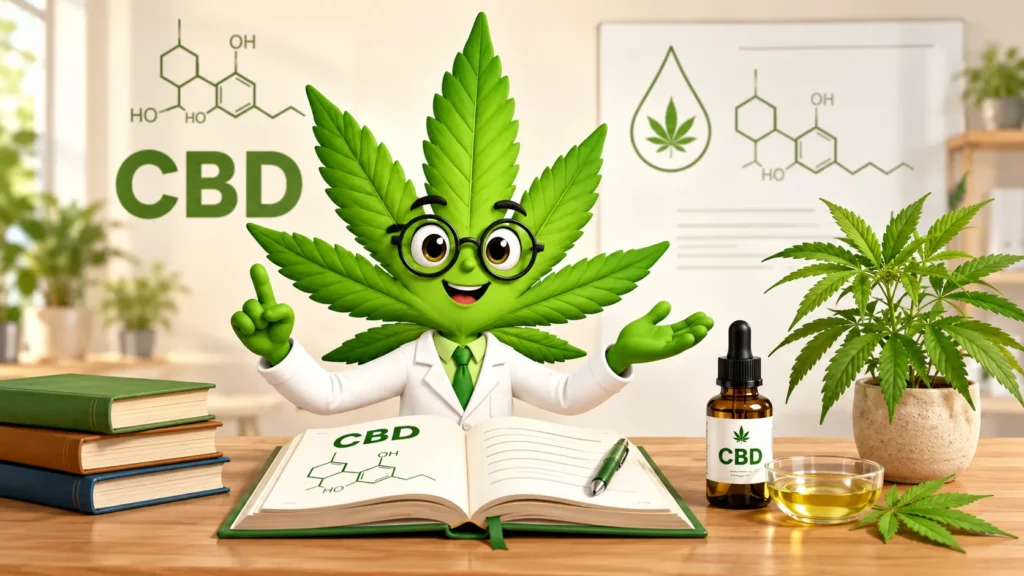
CBD stands for cannabidiol. Cannabidiol belongs to a group of compounds called cannabinoids and occurs naturally in the hemp plant Cannabis sativa L..
This page covers the basics: what CBD means, how it differs from hemp and THC, how CBD can be obtained from plant material and which types of products may contain it.
- This guide: definition, origin, basic terminology, production and common CBD product forms.
- CBD vs THC: intoxication, perception and the main differences between the two cannabinoids.
- Extract types: full-spectrum, broad-spectrum and CBD isolate.
- Lab reports: COAs, batch information, units and detection limits.
- Product quality: labeling, composition, documentation and traceability.
- Legal context: product type, intended use and jurisdiction-specific rules.
CBD Explained in Simple Terms
CBD is an individual compound found in hemp. Its full name is cannabidiol. CBD belongs to a larger group of compounds called cannabinoids, which also includes THC, CBG, CBN, CBC and their respective precursor forms.
The term CBD describes the compound cannabidiol itself. It does not tell you what type of finished product you are looking at, how concentrated it is, what other ingredients it contains or how that product is classified in a particular market.
| Term | Simple Meaning | Not Automatically the Same As |
|---|---|---|
| CBD | Abbreviation for cannabidiol. | Hemp, THC or a particular finished product. |
| Cannabidiol | The full name of the cannabinoid CBD. | CBD oil or cannabis oil. |
| Hemp | A cannabis plant used to produce fibres, seeds, extracts and other materials. | A guaranteed CBD concentration. |
| Cannabis | A broad term covering plants and products with very different properties. | Automatically an intoxicating product. |
| Cannabinoid | A group of compounds that includes CBD and THC. | A product category or quality grade. |
What Does Cannabidiol Mean?
Cannabidiol is the full name of the compound usually abbreviated as CBD. On product pages, labels and laboratory reports, the abbreviation CBD is used far more often than the full chemical name.
Cannabidiol is one of several cannabinoids that may occur in the cannabis plant. CBD is often mentioned alongside terms such as CBD oil, hemp extract, full-spectrum or isolate. These terms describe different characteristics of a product and should not be treated as interchangeable.
| Level | Example | Question It Answers |
|---|---|---|
| Individual compound | CBD or cannabidiol | Which cannabinoid is being discussed? |
| Extract type | Full-spectrum, broad-spectrum or isolate | How broad is the cannabinoid and plant-compound profile? |
| Product form | Oil, capsule, cream or gummy | How is the finished product supplied? |
| Concentration | Percentage, mg/ml or mg per unit | How much CBD is stated? |
| Intended use | Food, cosmetic or another product category | How is the finished product marketed and classified? |
Where Does CBD Come From in the Hemp Plant?
Cannabinoids are mainly associated with resin-producing structures in the above-ground parts of the plant. Flowers and areas close to the flowers are particularly relevant. Hemp seeds do not naturally contain the same cannabinoid profile as flower-derived plant material or extracts.
This explains a common source of confusion: hemp seed oil and CBD oil are not the same thing. Hemp seed oil is produced from seeds and may be used as a carrier oil. CBD oil contains an additional CBD-containing ingredient or extract combined with a liquid base.
Hemp is the plant. Cannabidiol is an individual compound. Hemp seed oil is an oil produced from seeds. CBD oil is a finished product containing CBD and a liquid base.
CBD, Hemp and Cannabis Are Different Terms
The words hemp and cannabis can be used differently depending on context. Botanically, they refer to plants within the genus Cannabis. In everyday language, hemp is often used for plants and products that are not associated with the typical intoxicating effects of high-THC cannabis.
Hemp can be used to produce very different materials and products, including fibres, seeds, edible oils, cosmetic ingredients, extracts and CBD-containing products. A reference to hemp alone therefore does not tell you whether a product contains CBD or how much CBD is present.
- Hemp fibre or textiles: primarily use structural plant fibres.
- Hemp seed oil: produced from seeds and may be sold as an edible oil or used as a carrier oil.
- Hemp extract: may contain a range of plant compounds and cannabinoids.
- CBD isolate: highly purified cannabidiol used as an ingredient.
- Finished CBD product: combines a CBD-containing ingredient with other ingredients and a specific product format.
CBD and THC Are Not the Same Compound
CBD and THC are both cannabinoids, but they are not treated as the same compound. THC is particularly associated with intoxication and changes in perception. CBD does not produce the typical THC high.
That distinction is enough for a basic definition of CBD. Questions about intoxication, perception, “THC-free” claims and possible THC traces in CBD products belong in the dedicated CBD vs THC guide.
Values such as CBD, CBDA, THC and THCA are usually reported separately in laboratory documentation. Understanding those values also requires looking at units, detection limits and the type of analysis used.
How Is CBD Produced?
For CBD products, cannabidiol may be obtained from suitable plant material and then further processed, or a purified CBD ingredient may be used in the final formulation. The exact manufacturing process depends on the producer, starting material and intended final product.
- Select plant material: suitable CBD-containing parts of the hemp plant are chosen.
- Produce an extract: plant compounds are separated from the material using an appropriate extraction process.
- Refine the extract: unwanted components may be reduced or removed.
- Define the profile: the material may be processed into a full-spectrum, broad-spectrum or more highly purified isolate ingredient.
- Formulate the finished product: the CBD-containing ingredient may be combined with a carrier oil, capsule shell, cosmetic base or another formulation.
An extraction method alone does not prove product quality. Product identity, composition, batch information and supporting documentation still need to be assessed separately.
What Are Cannabinoids?
Cannabinoids are a group of chemical compounds. Different cannabinoids and their precursor forms can occur in the cannabis plant. CBD is only one member of this larger group.
| Abbreviation | Name | How It Relates to This Guide |
|---|---|---|
| CBD | Cannabidiol | The main compound covered on this page. |
| CBDA | Cannabidiolic acid | A related precursor that may appear separately in laboratory reports. |
| THC | Tetrahydrocannabinol | A different cannabinoid particularly associated with intoxication. |
| THCA | Tetrahydrocannabinolic acid | A related precursor that should not simply be treated as identical to delta-9 THC. |
| CBG | Cannabigerol | Another cannabinoid that may occur in some plant profiles. |
| CBN | Cannabinol | Another cannabinoid that may appear in laboratory analysis. |
For beginners, the useful rule is simple: a cannabinoid name describes an individual compound. A product name describes a finished item that may contain several different compounds and ingredients.
What Role Do Terpenes and Other Plant Compounds Play?
Hemp contains other groups of compounds in addition to cannabinoids. These can include terpenes, flavonoids, waxes and other plant components. Whether they are present in a finished extract, and in what amounts, depends on the starting material and processing method.
Terpenes contribute to the characteristic aromas of many plants. A claim such as “broad plant profile” does not automatically mean that every possible terpene or cannabinoid is present.
Which Types of Products Can Contain CBD?
Cannabidiol can be used in different types of finished products. The product form describes how the finished item is made and supplied. This is separate from both the extract type and the CBD concentration.
| Product Form | Typical Structure | What Still Needs to Be Checked |
|---|---|---|
| CBD oil | CBD-containing ingredient combined with a carrier oil. | Extract type, CBD amount, carrier oil and labeling. |
| Capsules | CBD-containing formulation inside a capsule shell. | Amount per capsule, ingredients and pack size. |
| Cosmetics | CBD included in a cream, serum or other cosmetic base. | Ingredients, intended use and labeling. |
| Gummies or similar products | CBD in a solid formulation with other ingredients. | Amount per unit, total amount and product category. |
| Flower or plant material | Dried plant material with a naturally occurring cannabinoid profile. | Intended use, THC information and legal classification. |
| CBD isolate | Highly purified CBD ingredient. | Purity, intended use and composition of the finished product. |
The product format alone does not answer questions about quality or legal status. Those depend on additional information such as composition, documentation, intended use and the rules of the relevant jurisdiction.
CBD Oil, Hemp Oil and Cannabis Oil Are Not Automatically the Same
These terms are often mixed together in everyday use. Separating them makes product pages and labels easier to understand.
| Term | Typical Meaning | Important Limitation |
|---|---|---|
| CBD oil | A CBD-containing ingredient in a carrier oil. | Extract type and CBD concentration can vary substantially. |
| Hemp seed oil | Plant oil produced from hemp seeds. | Does not automatically contain a meaningful amount of CBD. |
| Hemp oil | An imprecise term often used for hemp seed oil. | The ingredient list is needed to determine what the product actually contains. |
| Cannabis oil | An ambiguous term used for very different oils and extracts. | It cannot be clearly classified without knowing the composition. |
What Does CBD Concentration Tell You?
CBD concentration describes how much cannabidiol is stated or measured in a product. Depending on the product, it may be expressed as a percentage, milligrams per millilitre, milligrams per gram or milligrams per individual unit.
A higher percentage does not automatically mean higher product quality. Concentration, product form, extract type, fill volume and documentation answer different questions.
The number alone is not enough. A CBD value becomes meaningful only when it is read together with the unit, fill volume, product form and appropriate laboratory documentation.
What the Term CBD Does Not Prove
The word CBD on a label does not prove a particular effect or level of quality. It also does not automatically mean that a product is THC-free, legally permitted in every market or suitable for every use.
- No guarantee of effect: the name of a compound does not prove a medical effect for an individual person.
- No quality seal: CBD identifies an ingredient or compound, not the overall quality of the manufacturer or finished product.
- No THC guarantee: depending on the extract type, a finished CBD product may contain other cannabinoids.
- No universal legal guarantee: classification depends on the specific product, composition, intended use and jurisdiction.
- No complete product description: ingredients, concentration, batch information and the responsible company still need to be checked separately.
Which CBD Wiki Topic Should You Read Next?
| Question | Next Topic | Main Focus |
|---|---|---|
| What is the difference between CBD and THC? | CBD vs THC | Intoxication, perception and compound differences. |
| How do extract types differ? | Full-Spectrum vs Broad-Spectrum vs CBD Isolate | Plant profile and THC content. |
| How do I read a laboratory report? | CBD Certificate of Analysis | COAs, batches, units and CBD/THC values. |
| How can product quality be assessed? | CBD Quality | Product identity, labeling, documentation and traceability. |
| What is CBD oil? | CBD Oil | Carrier oils, concentration and product terminology. |
| How is CBD regulated? | Country-Specific CBD Legal Guides | Product category, intended use and local rules. |
| What else should I know about CBD? | CBD Glossary | Short definitions covering the wider CBD topic. |
Official Information About CBD
For medical, food-safety or legal questions, current information from public authorities should be given more weight than marketing claims made on product pages. The relevance of a particular authority also depends on the country and product category involved.
- EFSA: Cannabidiol and Novel Food safety assessment
- German BVL: FAQ on cannabidiol in foods and food supplements
- German BfR: Hemp-containing foods and potential health risks
What Is CBD in Simple Terms?
CBD is short for cannabidiol, a cannabinoid found naturally in the hemp plant. CBD is not the same thing as hemp, hemp seed oil, THC or a particular finished product.
To understand a CBD product properly, several separate factors need to be considered: the compound itself, extract type, product form, concentration, composition and intended use. These basics provide the foundation for the rest of the SaveSleuth CBD Wiki.
Frequently Asked Questions About CBD
What is CBD in simple terms?
CBD stands for cannabidiol. Cannabidiol is a cannabinoid that occurs naturally in the hemp plant.
Is CBD the same as hemp?
No. Hemp is the plant. CBD is an individual compound that may occur in certain parts of the plant.
Is CBD the same as THC?
No. CBD and THC are different cannabinoids. THC can produce intoxicating effects, while CBD does not produce the typical THC high.
Is hemp seed oil a CBD oil?
Not automatically. Hemp seed oil is produced from seeds and may be used as a carrier oil. CBD oil contains an additional CBD-containing ingredient or extract.
Which products can contain CBD?
CBD may be used in oils, capsules, cosmetics, solid formulations and plant extracts. Product form, extract type and concentration are separate characteristics.
Does a higher CBD percentage automatically mean better quality?
No. CBD percentage describes concentration or quantity. Product quality also depends on identity, composition, labeling, batch information and supporting documentation.