

The history of cannabis cannot be reduced to a single discovery, an ancient remedy or a modern legalization date. Evidence ranges from preserved plants in a 2,700-year-old tomb to chemical residues in burial braziers, nineteenth-century medical papers and twentieth-century drug treaties. Each source answers a different question. To understand the plant’s global history, those questions must be kept separate.
This SaveSleuth research guide follows Cannabis as a plant: its early history, hemp uses, archaeological traces of psychoactive practices, scientific investigation and changing legal status. It is not the same subject as the discovery of cannabidiol (CBD), a single compound isolated and studied much later. We link to original studies and legal texts where possible and explain what the evidence does not establish.
- Cannabis: a plant with a long and geographically varied history.
- Industrial hemp: cannabis cultivated or used for fibre, seeds and other non-intoxicating purposes.
- CBD and THC: individual cannabinoids, whose isolation, structure and pharmacology belong to modern chemical research.
A world history of cannabis: the evidence-based timeline
| When | Documented milestone | Important qualification |
|---|---|---|
| Early Neolithic, estimated | Genomic modelling places early domestication processes in East Asia, with a divergence estimate around 12,000 years before present. | A model estimate is not the discovery of a 12,000-year-old hemp field. |
| About 2,700 years ago | Preserved cannabis was recovered from a tomb at Yanghai, in present-day Xinjiang. | Plant material alone does not establish a precise method of use. |
| About 500 BCE | Chemical residues in braziers at Jirzankal indicate cannabis burning during mortuary rituals. | It does not document a universal ancient custom. |
| 1839–1843 | W. B. O’Shaughnessy published medical investigations of Indian hemp. | Historical treatment reports are not present-day clinical evidence. |
| 1940–1964 | Scientific work on CBD and THC advanced the chemistry of individual cannabinoids. | The plant itself had been known for millennia. |
| 1961 | The UN Single Convention established an international drug-control framework covering cannabis. | Treaty controls and domestic laws are distinct. |
| 1970 | The US Controlled Substances Act established a federal scheduling system. | Subsequent US state and federal policy developments must be examined separately. |
| 2013 | Uruguay enacted Law No. 19,172 on cannabis regulation and control. | Its framework should not be equated with another country’s model. |
| 2018 | Canada’s Cannabis Act came into force on October 17. | Regulated legal access is not unrestricted access. |
| 2020 | A UN commission removed cannabis and cannabis resin from Schedule IV of the 1961 treaty. | They remained in Schedule I; it was not worldwide legalization. |
| 2024 | Germany’s Cannabis Act introduced adult private cultivation and non-commercial collective cultivation rules. | Germany did not introduce the same retail model as Canada. |
The timeline contains three different types of dates: scientific estimates, dated archaeological evidence and legal enactments. Presenting all three as equally certain would distort the record.
Where did cannabis originate? What genomics actually tells us
A 2021 study by Ren and colleagues, published in Science Advances, analysed whole-genome data to reconstruct the domestication history of Cannabis sativa. The authors’ model points toward early domestication in East Asia. It places a divergence of early domesticated ancestors from basal cannabis at roughly 12,000 years before present, but gives a 95% confidence interval extending from about 6,458 to 15,728 years. That span matters: the figure is a model-based evolutionary estimate, not a precise archaeological date. Read the 2021 original genomic study.
The study also discusses archaeological traces of fibre use, pottery-associated seeds and later expansion of different lineages. However, neither a genetic divergence nor an isolated fibre impression can by itself answer when people first deliberately cultivated the plant for a particular purpose. More than one line of evidence is needed: botanical identification, dating context, associated tools and sometimes chemical analysis.
This is why a simple statement such as “cannabis was first grown exactly 12,000 years ago” is misleading. The genomic findings are important without turning statistical reconstruction into an invented farm or a single founding civilization.
For a closer study of the East Asian record, see Cannabis in Ancient China: Archaeology, Hemp and Early Evidence. It compares the Haimenkou seed assemblage, early hemp textiles, Yanghai and Jirzankal burial finds and the dating of Chinese medical texts.
How archaeologists distinguish hemp, cannabis and intoxication
Different kinds of archaeological evidence support different conclusions. Seeds, fibres or pollen can document a plant’s presence or processing. Preserved flowers can reveal botanical and chemical features. Residues from a heated vessel may point to burning, but even then researchers must interpret the context carefully.
| Evidence type | What it may establish | What remains uncertain |
|---|---|---|
| Seeds, fibre impressions, textiles | Presence, processing or use of plant material. | Whether it was used to produce psychoactive effects. |
| Preserved plant matter | Botanical identity; sometimes chemical constituents. | How, and by whom, the plant was consumed or handled. |
| Residues in burned vessels | Possible burning of cannabinoid-containing plants. | Exact exposure, purpose and social meaning without other context. |
| Historical writings | What authors reported or believed at a specific time. | Whether claims reflect widespread practice or modern scientific truth. |
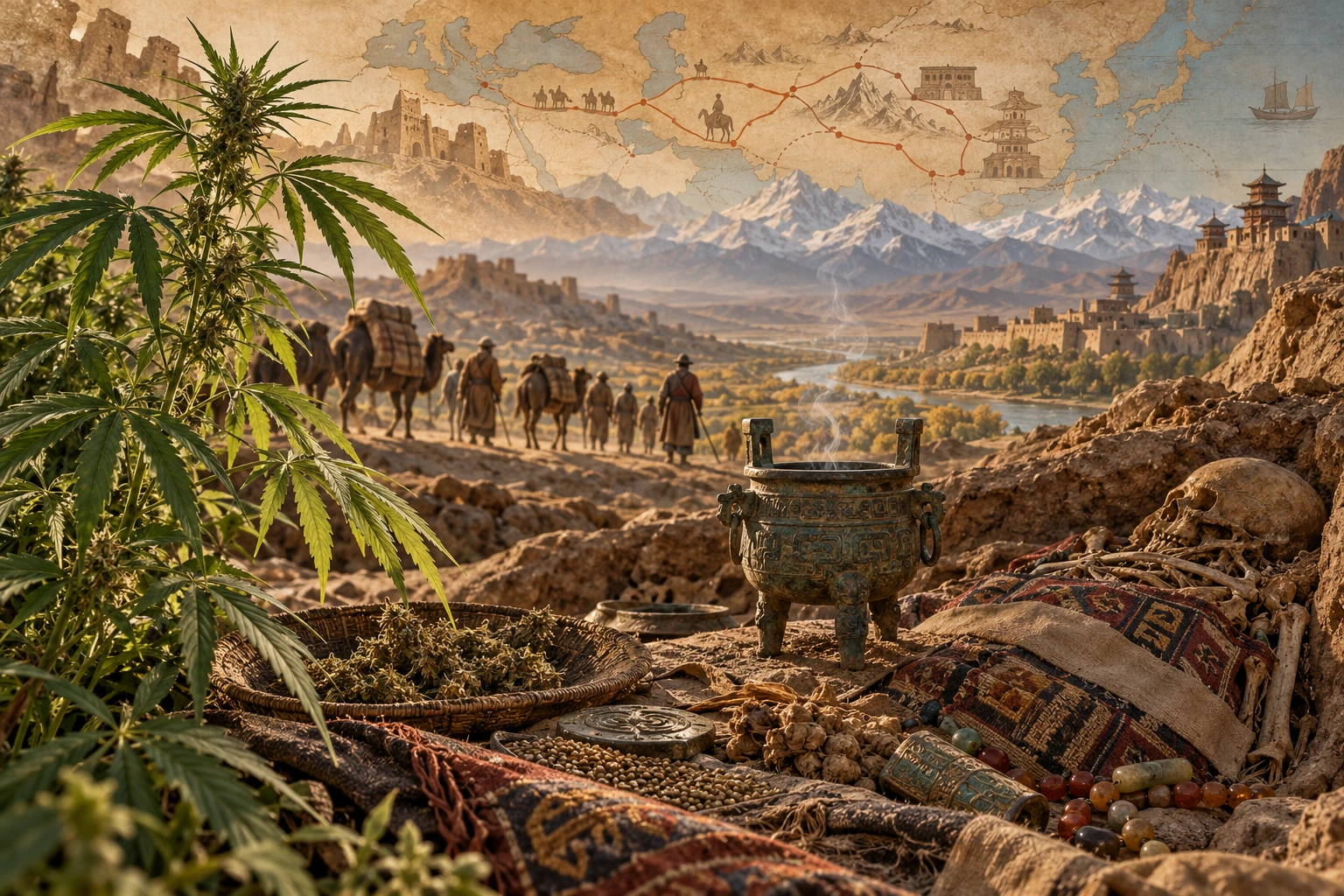
Yanghai, around 2,700 years ago: cannabis in a burial
At the Yanghai Tombs near Turpan in northwestern China, archaeologists recovered an unusually well-preserved cache of cannabis from a burial dated to roughly 2,700 years ago. In a 2008 paper in the Journal of Experimental Botany, researchers reported botanical observations, chemical analyses and genetic testing of the material. Their investigations identified evidence consistent with cannabinoids and enzymes associated with cannabinoid production. Read the original Yanghai analysis (2008).
The authors considered medicinal, psychoactive and divinatory interpretations. But it is important not to treat any one of these possibilities as a directly observed action: the burial provides physical evidence that cannabis held significance in that context. It does not give us a witnessed account of how the deceased or their community used it.
The find belongs to the wider history of Central Eurasia before the classical Silk Road reached its best-known form. Still, modern borders should not be projected backward as if they defined ancient cultures.
Jirzankal, around 500 BCE: cannabis residues in funeral braziers
Another major discovery comes from the Jirzankal Cemetery on the Pamir Plateau, in what is now western China. A 2019 Science Advances study analysed charred deposits from ten wooden braziers and four burned stones. Researchers detected cannabinoid-related chemical traces, notably cannabinol (CBN), which can form as THC oxidizes. They interpreted the results as evidence that cannabis had been burned during funerary ceremonies approximately 2,500 years ago. Read the original Jirzankal chemical-residue study (2019).
Jirzankal is significant because the claim is grounded in chemical analysis of the objects used in the ceremonies, not only in later written tradition. Yet “cannabis was burned at this cemetery” is narrower than “everyone in ancient Central Asia smoked cannabis.” The chemical result does not quantify what each participant inhaled or establish how common the practice was beyond the burial context.
The distinction between Yanghai and Jirzankal matters. Yanghai offers preserved plants in a grave; Jirzankal provides residue evidence from heated ritual equipment. Combining the two indiscriminately creates a stronger story than either excavation actually proves.
Cannabis as a fibre crop, a traded material and a regional tradition
The plant’s history did not travel along only one road. Hemp fibres, seeds, resin and preparations had different economic and cultural uses, and those uses developed unevenly between regions. The story of hemp in textiles or agriculture is not identical to the history of medicinal preparations or ritual burning.
A future regional series in this Wiki will therefore examine East Asia (early plant evidence and textile history), South Asia (medical writing and varied cultural traditions), Central Asia (archaeology and exchange networks), Europe (fibre cultivation and medicine) and Africa and the Americas (documented regional uses, historical exchange and modern national regulation). Each regional article will need archaeological or documentary evidence specific to that place. A modern cultural story should never be projected unchanged onto prehistoric people.
From Indian hemp to nineteenth-century medical literature
William Brooke O’Shaughnessy investigated Indian hemp in colonial-era medical settings in India. His study was reported to the Medical and Physical Society of Calcutta and circulated in an 1843 version in the Provincial Medical and Surgical Journal. The published title described experiments and clinical observations involving what the author called Indian hemp or “gunjah.” Read O’Shaughnessy’s 1843 paper.
This document is valuable because it shows precisely how a nineteenth-century physician investigated and described cannabis, including assumptions and methods typical of his period. It is not appropriate to turn historical claims into present-day health advice. Modern treatment decisions need contemporary evidence, product-specific safety data and professional guidance.
1940–1964: the plant becomes a subject of modern cannabinoid chemistry
Cannabis is much older than its chemical study. Work around 1940 by Roger Adams and others helped isolate and describe cannabidiol, while later research clarified cannabinoid structures. In 1964, Yechiel Gaoni and Raphael Mechoulam published work on the isolation, structure and partial synthesis of an active constituent of hashish associated with THC. See the 1964 original paper in the Journal of the American Chemical Society.
These milestones must not be presented as the moment cannabis “was discovered.” They marked the identification and structural understanding of specific chemical compounds from an already familiar plant. For an unusually detailed reconstruction of the CBD side of the story, our Roger Adams and 1940 investigation compares original papers, a US patent and parallel scientific work.
The scientific histories of cannabinoids and CBD versus THC belong in separate specialist guides; research advances do not by themselves prove that any commercial product is effective or safe.
The 1961 UN treaty and the 2020 scheduling decision
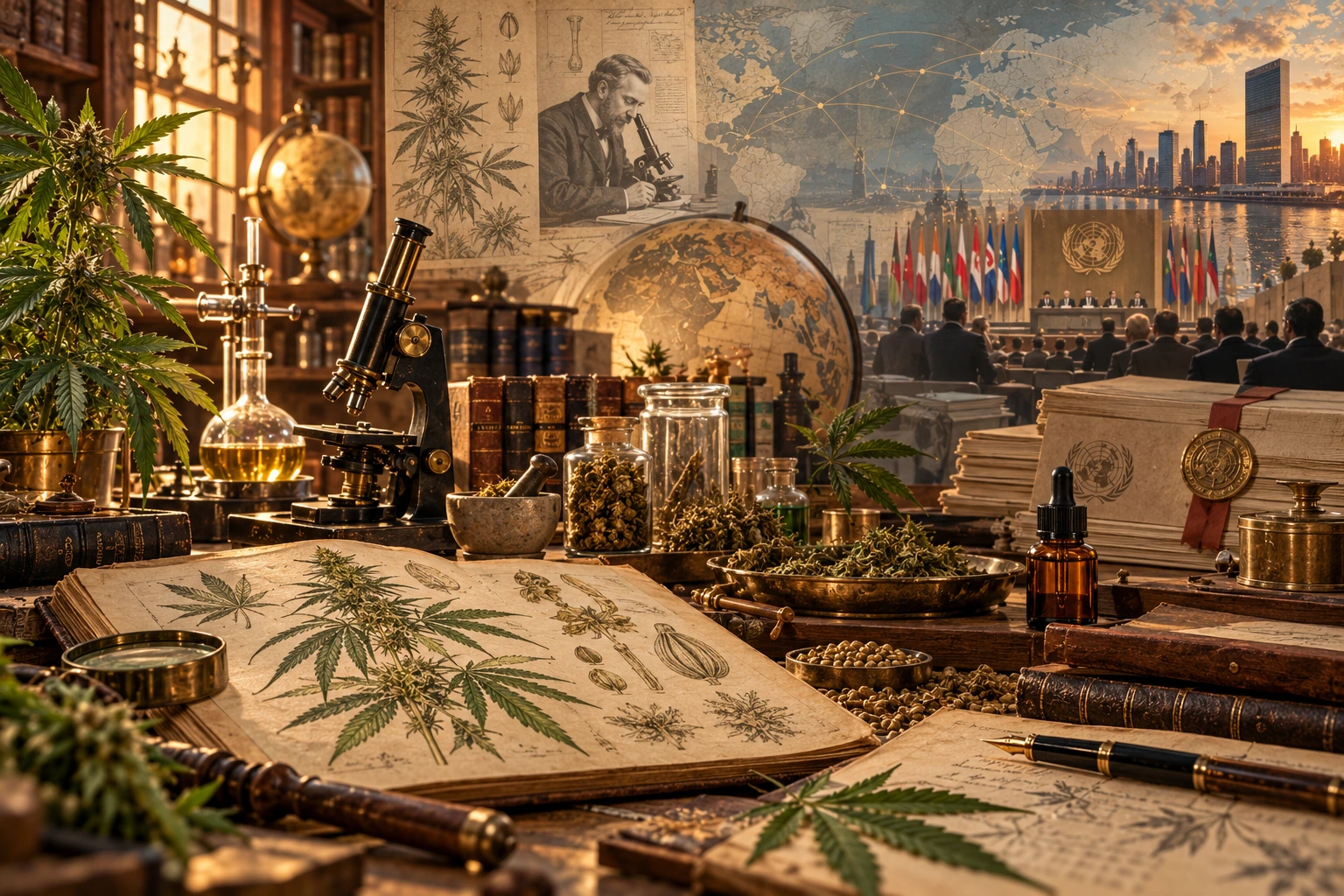
The 1961 Single Convention on Narcotic Drugs became a central document in international control of cannabis. The relationship between this treaty, later scientific reviews and domestic reforms is often oversimplified. A particularly important example occurred on December 2, 2020, when the UN Commission on Narcotic Drugs voted 27 to 25, with one abstention, to remove cannabis and cannabis resin from Schedule IV of the 1961 Convention.
Cannabis and cannabis resin nevertheless remained in Schedule I. The decision was a change in international scheduling following WHO review, not an announcement that every country had legalized cannabis. The UN Office on Drugs and Crime recorded both the vote and the continuing Schedule I controls in its official statement of December 2, 2020.
An important wider lesson follows: international treaty categories, domestic possession rules, medical access and rules for licensed commercial sales are four different questions. A change in one does not automatically change all of the others.
Uruguay, Canada, Germany and the United States: different legal histories
Uruguay: a national control framework in 2013
Uruguay enacted Law No. 19,172 on December 20, 2013. The text established a state regulatory approach to production, distribution and access, framed in part around public health and harm reduction. The law’s official record lists publication in January 2014. The framework should be read through the country’s own institutions and later regulations, not used as a template for claims about other countries. Uruguay’s official law text.
Canada: a national legal framework from October 2018
Canada’s Cannabis Act came into force on October 17, 2018. It established rules for legal access and for the production, distribution, sale and possession of cannabis, with public-health and youth-protection aims. “Legal in Canada” is not a synonym for being available to every person, from every seller or in every situation. Health Canada’s official implementation backgrounder.
Germany: private cultivation and non-commercial associations in 2024
Germany’s Cannabis Act, which entered into force on April 1, 2024, established adult private self-cultivation rules and a framework for collective, non-commercial cultivation through associations. It should not be confused with Canada’s national retail market structure. German Federal Ministry of Health’s legislative record.
United States: federal drug scheduling and different jurisdictions
The US Controlled Substances Act introduced a federal system of five schedules in 1970. Cannabis policy in the United States also developed through state legislation and administrative processes. A full modern comparison must separate federal law from state-level rules and specify the date of the legal check. Federal scheduling framework in 21 U.S.C. § 812.
For all four jurisdictions, the dates above describe historical milestones. They are not a current permission guide. A lawful activity in one country, state or context may remain restricted somewhere else, and regulatory details can change.
Five familiar claims that overstate the historical record
- “Cannabis was discovered in 1940.” No. The 1940 milestone concerns research on CBD, not discovery of the plant.
- “A 12,000-year-old cannabis farm has been excavated.” No. The often cited number is a model-based estimate with substantial uncertainty.
- “Every ancient reference to hemp describes intoxication.” No. Seeds, fibre, medicines and ritual practices require separate interpretations.
- “The UN legalized cannabis in 2020.” No. Removal from Schedule IV left cannabis in Schedule I.
- “Legalization is the same in every country.” No. Uruguay, Canada, Germany and US jurisdictions have different regulatory histories.
How SaveSleuth verifies cannabis-history claims
We evaluate a claim against the type of evidence available, not against how often the story is repeated online. For archaeological dates we look for the excavated context and the dating method; for chemical identifications, the sampling and analytical techniques; for ancient texts, the edition, original language and historical context; and for laws, the official enacted wording and its amendments.
We also distinguish observation from interpretation. A plant recovered from a tomb is an observation. Calling the deceased person a healer, or treating the object as proof of a particular ceremony, is an interpretation that needs its own support. Likewise, an old medical publication establishes what researchers reported at the time, not a clinical recommendation today.
This Wiki remains editorially separate from SaveSleuth’s commercial CBD guides, merchant listings and affiliate pages. Primary sources are linked alongside the claims they support. Where uncertainty survives, it is part of the story rather than something to conceal.
Related research in the SaveSleuth Wiki
- The discovery of CBD in 1940: original studies, Minnesota hemp and Roger Adams
- What is CBD? The molecule and the plant
- Cannabinoids: how CBD, THC and related compounds differ
- CBD vs THC: biological and product distinctions
- Cannabinoid testing: understanding chemical evidence
Frequently asked questions about the history of cannabis
Where did cannabis originally come from?
Genomic research indicates very early domestication processes in East Asia, but it does not identify an exact first farm or a single historically documented founder.
What is the earliest evidence of cannabis smoking?
The Jirzankal residue study documents cannabis burning in a burial context around 500 BCE and is among the earliest directly analysed evidence for ritual smoking. It does not establish the earliest use everywhere.
Was cannabis used before scientists discovered CBD?
Yes. Archaeological evidence of plant use is thousands of years older than the isolation of cannabidiol as a distinct compound in the twentieth century.
Did the United Nations legalize cannabis in 2020?
No. Cannabis and cannabis resin were removed from Schedule IV of the 1961 Single Convention but remained in Schedule I.
Are national cannabis laws comparable?
They can be compared, but only by separating possession, age limits, home cultivation, medical access, commercial supply, advertising and the date at which the law is checked.
Research checked: October 20, 2026. This page is a historical and scientific overview. It is not medical, legal or consumption advice. Legal provisions may change after publication.