

Cannabinoid Testing: HPLC vs GC Explained
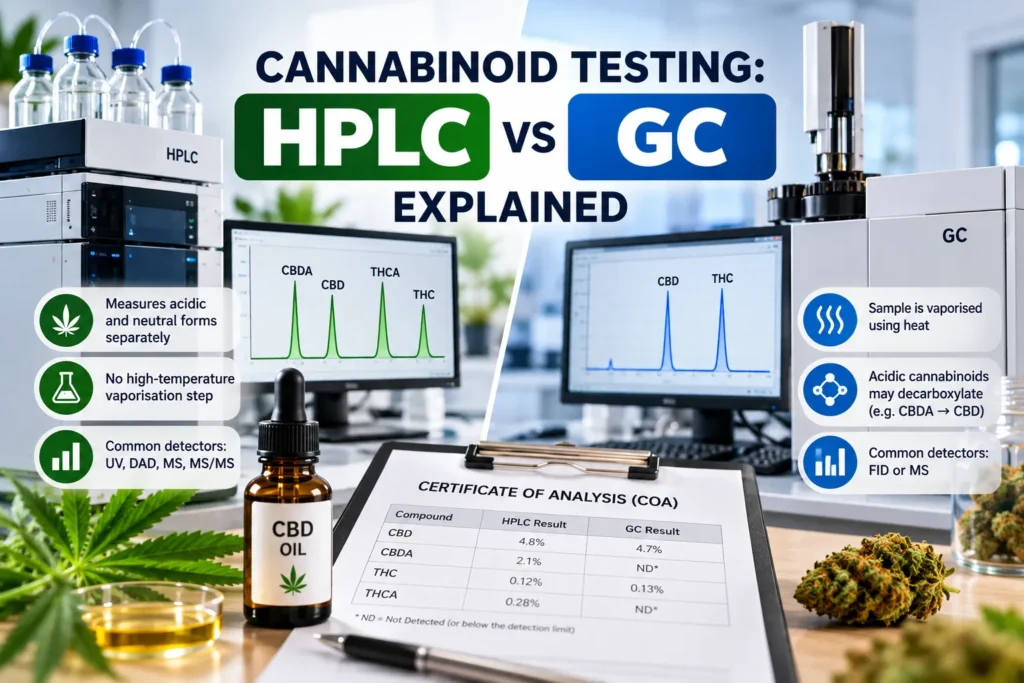
CBD laboratory reports often contain detailed cannabinoid results, but the numbers do not exist independently of the testing method. Two of the most widely discussed approaches are HPLC, or high-performance liquid chromatography, and GC, or gas chromatography.
The main practical difference is how the methods handle the sample. HPLC can measure acidic and neutral cannabinoid forms separately without heating them during chromatographic separation. Conventional GC uses heat to vaporise the sample, which can convert acidic cannabinoids such as CBDA and THCA into CBD and THC unless the method includes additional sample preparation.
- HPLC: can usually report CBD and CBDA, or THC and THCA, as separate values.
- GC: heating can change acidic cannabinoids during analysis unless the method is designed to prevent it.
- Total values: may therefore depend on the analytical method and calculation used by the laboratory.
- The method name alone is not a quality score: sample preparation, validation, calibration and reporting also matter.
HPLC vs GC at a Glance
| Feature | HPLC | GC |
|---|---|---|
| Full name | High-performance liquid chromatography | Gas chromatography |
| Sample during separation | Remains in a liquid mobile phase | Sample is vaporised and carried as a gas |
| Heat during analysis | No high-temperature vaporisation step | Requires a heated injector and column conditions |
| CBD and CBDA | Can be measured separately | CBDA may decarboxylate unless the method prevents it |
| THC and THCA | Can be measured separately | THCA may decarboxylate unless the method prevents it |
| Common detector examples | UV, DAD, MS or MS/MS | FID or MS |
| Useful for | Native cannabinoid profiles including acidic forms | Volatile analysis and methods designed around total or derivatised cannabinoids |
This comparison is simplified. Laboratories can modify sample preparation, chromatographic conditions and detection systems, so the exact capabilities depend on the validated method rather than the letters HPLC or GC alone.
What HPLC Does in Cannabinoid Testing
HPLC separates compounds while the sample travels through a chromatographic column in a liquid mobile phase. The process does not require the sample to be vaporised at the high temperatures used in gas chromatography.
That makes HPLC particularly useful when a laboratory wants to distinguish between neutral cannabinoids and their acidic precursors. A cannabinoid profile may therefore show separate rows for CBD and CBDA, or THC and THCA.
An HPLC report may list CBD, CBDA, delta-9 THC and THCA as separate analytes. A calculated “Total CBD” or “Total THC” can then appear as an additional value rather than replacing the individual measurements.
What GC Does in Cannabinoid Testing
Gas chromatography requires compounds to enter the analytical system in a gaseous state. The sample is therefore exposed to high temperatures in the injector before travelling through the GC column.
That heating matters for cannabinoids because acidic forms such as CBDA and THCA are thermally sensitive. They can lose carbon dioxide through decarboxylation, producing the corresponding neutral cannabinoids CBD and THC.
Without appropriate sample preparation, a GC result may therefore not represent the original acidic and neutral cannabinoid profile in the same way as a liquid-chromatography result.
Why Decarboxylation Changes the Report
Cannabis and hemp can contain both acidic and neutral cannabinoid forms. Examples include CBDA and CBD, THCA and THC, and CBGA and CBG.
Heat can convert acidic cannabinoids into their neutral counterparts. If this happens inside the analytical instrument, the final chromatogram may describe a chemically altered version of the original sample unless the laboratory method accounts for that conversion.
| Acidic Form | Neutral Form | Why It Matters |
|---|---|---|
| CBDA | CBD | A heated method can change how CBD-related content appears in the result. |
| THCA | THC | Heating can affect how THC-related values are reported or interpreted. |
| CBGA | CBG | The native cannabinoid profile can differ from the profile after heating. |
The underlying cannabinoid forms are explained in more detail on the Cannabinoids page.
Can GC Measure Acidic Cannabinoids?
Yes, but the method requires additional consideration. Laboratories can use a chemical preparation step known as derivatisation to make acidic cannabinoids more suitable for GC analysis and reduce unwanted thermal conversion.
This means it would be too simplistic to say that GC “cannot test THCA or CBDA”. The more accurate question is whether the specific GC method was designed and validated to distinguish the acidic compounds from their neutral counterparts.
HPLC-UV, HPLC-DAD and LC-MS Are Not the Same Thing
The chromatography method and the detector should be considered separately. HPLC describes how the compounds are separated; terms such as UV, DAD and MS describe how compounds are detected after or during that separation.
| Term | What It Refers To | Practical Meaning |
|---|---|---|
| HPLC-UV | Liquid chromatography with ultraviolet detection | Common approach for quantifying cannabinoids that absorb UV light. |
| HPLC-DAD | Liquid chromatography with diode-array detection | Collects absorbance information across multiple wavelengths. |
| LC-MS | Liquid chromatography coupled to mass spectrometry | Provides mass-based information that can improve compound identification. |
| LC-MS/MS | Liquid chromatography with tandem mass spectrometry | Can provide high selectivity and sensitivity for targeted compounds. |
A laboratory report may use “LC” rather than “HPLC”. LC is the broader term for liquid chromatography, while HPLC describes a widely used high-performance form of the technique.
GC-FID and GC-MS Also Use Different Detectors
Gas chromatography can likewise be paired with different detectors. Two common terms are GC-FID and GC-MS.
| Term | Detector | What It Adds |
|---|---|---|
| GC-FID | Flame ionisation detector | Widely used for quantitative analysis of organic compounds. |
| GC-MS | Mass spectrometer | Adds mass-spectral information useful for compound identification. |
Again, the detector name does not by itself prove that a result is accurate. The complete analytical method includes sample preparation, separation, detection, calibration, controls and data processing.
Why HPLC Is Common for CBD and Cannabinoid Profiles
For cannabinoid profiles where CBD, CBDA, THC and THCA need to be distinguished, liquid chromatography has a practical advantage: the acidic compounds can be analysed directly without deliberately heating the sample first.
This is especially useful when the original cannabinoid composition matters. It also explains why many CBD COAs show separate acidic and neutral cannabinoid rows produced by liquid-chromatography methods.
Why Laboratories Still Use GC
GC remains an established analytical technique. It can provide effective separation and can be coupled with detectors such as FID and MS. Gas chromatography is also particularly well established for volatile compounds, including terpene analysis.
For cannabinoid testing, however, the heating step must be considered when acidic cannabinoids are relevant. A well-designed GC method can address this through sample preparation and method-specific calculations.
Is HPLC More Accurate Than GC?
Not as a universal rule. HPLC and GC are analytical platforms, not quality grades. Accuracy depends on whether the method is appropriate for the analytical question and whether the laboratory has validated it properly.
A poorly controlled HPLC method is not automatically better than a carefully validated GC method. Conversely, a GC method that ignores thermal conversion would not be suitable for every question about the native acidic cannabinoid profile.
Instead of asking “Is HPLC or GC better?”, ask whether the method can measure the cannabinoids relevant to the product and whether the report clearly explains what was tested and how the results were calculated.
What Method Validation Means
A laboratory method should be shown to perform reliably for its intended purpose. Depending on the method and testing context, validation can examine characteristics such as selectivity, calibration, accuracy, precision, detection limits and quantification limits.
That is why a method name alone is not enough to judge a COA. A report labelled “HPLC” still needs clear sample identification, units and laboratory information, just as a GC report does.
How HPLC and GC Affect Total CBD and Total THC
Laboratory reports may display individual cannabinoid forms and calculated total values. For example, a liquid-chromatography method may measure CBD and CBDA separately and then calculate a total CBD value according to the laboratory’s stated formula.
With GC, thermal conversion can occur before the compounds are measured unless derivatisation or another suitable approach is used. As a result, total cannabinoid values from different methods should not be compared purely by looking at the final number.
When reading a CBD Certificate of Analysis, check whether the report shows individual acidic and neutral forms, calculated totals, units and the analytical method used.
How to Read the Testing Method on a CBD COA
- Find the method. Look for HPLC, LC, GC or a more detailed method name.
- Check the detector. The report may mention UV, DAD, MS, MS/MS or FID.
- Look at the analytes. Are CBD, CBDA, THC and THCA listed separately?
- Check total values. Determine whether Total CBD or Total THC is measured directly or calculated from individual results.
- Read the units. Percentage, mg/g and mg/ml are not interchangeable without context.
- Check LOD and LOQ. Detection and quantification limits matter when values are very low or reported as ND.
- Match the batch. Even a technically strong method is of little value if the COA belongs to a different product or production lot.
Common Misunderstandings About HPLC and GC
| Claim | Better Interpretation |
|---|---|
| “HPLC means the product is high quality.” | HPLC is a testing method. Product quality requires a wider assessment. |
| “GC cannot measure cannabinoids.” | GC is widely used for cannabinoid analysis, but heat-related conversion must be handled appropriately. |
| “GC can never distinguish acidic cannabinoids.” | Special sample preparation such as derivatisation can make this possible. |
| “LC-MS is automatically more accurate than HPLC-UV.” | The detector can add sensitivity or selectivity, but overall accuracy still depends on method validation. |
| “Two COAs should show identical values.” | Sampling, preparation, analytical method and reporting conventions can all influence results. |
Testing Method Is Only One Part of CBD Quality
A sophisticated analytical technique does not compensate for a report that cannot be matched to the product. Product name, strength, batch number, laboratory identity and testing date remain fundamental.
Likewise, cannabinoid potency testing does not automatically mean that a sample was tested for pesticides, heavy metals, residual solvents or microbiological contamination. Those require their own testing panels.
For a wider product-level assessment, see How to Tell If CBD Is Good Quality.
HPLC vs GC in Simple Terms
HPLC separates cannabinoids in a liquid system and can analyse acidic and neutral forms without first vaporising the sample. That makes it well suited to reports that distinguish CBD from CBDA and THC from THCA.
GC vaporises the sample using heat. Without method-specific preparation, that heat can convert acidic cannabinoids into neutral forms. GC is still a powerful analytical technique, but the laboratory must account for this chemistry when the original cannabinoid profile matters.
For consumers reading a COA, the practical lesson is simple: do not judge a report from one number or one acronym. Check the method, analytes, units, calculated totals, analytical limits and batch information together.
← Back to the CBD Wiki | CBD Certificate of Analysis | CBD Quality | Cannabinoids | CBD vs THC
Frequently Asked Questions About HPLC and GC
What does HPLC mean on a CBD lab report?
HPLC stands for high-performance liquid chromatography. It is a laboratory separation method commonly used to measure cannabinoids such as CBD, CBDA, THC and THCA.
What does GC mean in cannabinoid testing?
GC stands for gas chromatography. The method vaporises a prepared sample and separates compounds as they travel through a chromatographic column.
Why can HPLC separate CBD from CBDA?
HPLC does not require the high-temperature vaporisation used in conventional GC, so thermally sensitive acidic cannabinoids such as CBDA can remain intact during analysis and be measured separately from CBD.
Why can GC change THCA into THC?
The heated GC injection process can cause THCA to decarboxylate into THC. Laboratories can use specialised sample preparation when separate measurement of the acidic form is required.
Is HPLC better than GC for cannabinoid testing?
Not in every situation. HPLC has a practical advantage when acidic and neutral cannabinoids need to be measured separately, while GC remains useful for suitable analytical applications. Method validation and the testing objective are more important than the acronym alone.
What is the difference between HPLC and LC-MS?
HPLC describes a liquid-chromatography separation technique. LC-MS combines liquid chromatography with mass spectrometry as the detector, providing additional mass-based information about the compounds being analysed.