

The Discovery of CBD: Roger Adams, Minnesota Wild Hemp and 1940
The modern scientific history of cannabidiol did not begin in a CBD shop or with the famous cannabis studies of the 1960s. It leads back to wild hemp growing in Minnesota, a US government laboratory processing roughly 40 kilograms of plant material, and a red oil that Roger Adams and his colleagues investigated in 1940.
From this material, cannabidiol — now usually abbreviated as CBD — was isolated and studied as a distinct chemical constituent of cannabis. But the history is more complicated than the familiar statement that “Roger Adams discovered CBD in 1940.”
At almost the same time, a British research group led by Alexander R. Todd and Anne Jacob was investigating cannabidiol from Cannabis indica resin. And the molecular structure of CBD accepted today was not fully established until more than two decades later.
To reconstruct the story, SaveSleuth compared the original 1940 papers, Roger Adams’ later US patent, contemporary scientific publications and later historical reviews of early cannabinoid research.
A separate history: This article examines cannabidiol as a chemical discovery. For the much older plant history — archaeological findings, industrial hemp, traditional uses and modern laws — see our world history of cannabis.
On This Page
CBD in 1940: The Key Facts at a Glance
| Plant material | Wild hemp from Minnesota, grown during the 1938 season |
| Material processed | About 40 kg of plant material |
| Extraction site | US Treasury Department Narcotics Laboratory, Washington, D.C. |
| Intermediate material | About 100 g of purified “red oil” |
| Key researchers | Roger Adams, Madison Hunt, J. H. Clark and colleagues |
| University | University of Illinois, Noyes Chemical Laboratory |
| Major CBD publication | Journal of the American Chemical Society, 1940 |
| CBD isolation patent | US2304669A; filed August 16, 1940; granted December 8, 1942 |
| Later structure work | Mechoulam & Shvo, 1963; Šantavý, 1964 |
Where Did the Hemp Used to Isolate CBD Come From?
The plant material was not a specially bred modern “CBD hemp” cultivar. Adams and his colleagues worked with what the original paper called “Minnesota wild hemp” — naturally growing or feral Cannabis sativa from Minnesota.
The 1940 paper by Roger Adams, Madison Hunt and J. H. Clark describes the source material in unusual detail. The hemp had grown in Minnesota during the 1938 season. It was cut in August after flowering had begun but before the seeds of the female plants were fully set.
The harvested material was then dried for about six weeks with air circulation. Coarse stems were removed afterwards. According to the historical description, these stems represented roughly one third of the dry weight.
These details appear in the original Journal of the American Chemical Society paper, Structure of Cannabidiol, a Product Isolated from the Marihuana Extract of Minnesota Wild Hemp. I.
About 40 Kilograms of Hemp Became Roughly 100 Grams of “Red Oil”
One of the most striking numbers in the early history of CBD is not found in modern marketing material. It comes from the reconstruction of the laboratory process that supplied Adams with cannabinoid-rich material.
At the US Treasury Department Narcotics Laboratory in Washington, D.C., a batch of approximately 40 kilograms of Minnesota hemp was processed. The plant material was extracted with 95% ethanol.
After concentration, purification and distillation, the large batch of plant material yielded only about 100 grams of purified red oil. That red oil was sent to Roger Adams’ laboratory at the University of Illinois and became the starting material for several important early cannabinoid studies.
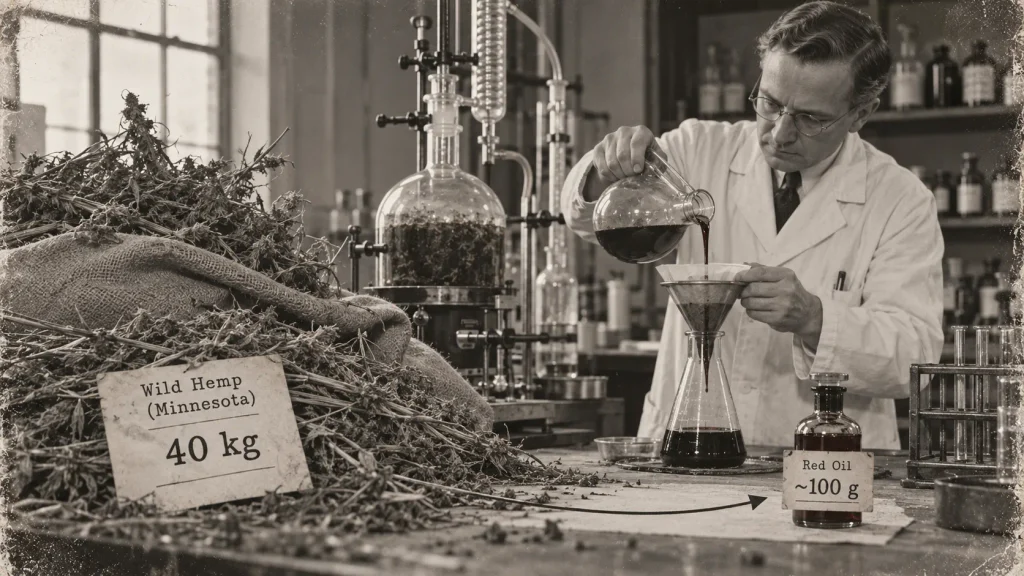
Science historian Crist N. Filer reconstructed this process from the early publications in his 2020 open-access paper Minnesota wild hemp: a crucial botanical source in early cannabinoid discovery.
40 kg → about 100 g: the unusually well-documented journey from roadside Minnesota hemp to a laboratory extract is one reason this episode remains so important in the history of cannabinoid chemistry.
The laboratory techniques used in cannabinoid research have changed dramatically since then. Our guide to cannabinoid testing: HPLC vs GC explains how modern analytical laboratories separate and measure compounds such as CBD, CBDA, THC and THCA.
What Exactly Did Roger Adams Discover in 1940?
Adams’ group was trying to separate the individual constituents of a chemically complex cannabis extract and determine their properties. One of those constituents was cannabidiol.
In the first 1940 paper, CBD was isolated from the Minnesota extract and a chemical structure was proposed. Other papers published during the same period examined the compound, its derivatives and its relationship to other cannabis constituents.
Another paper by Roger Adams, D. C. Pease and J. H. Clark carried the especially direct title Isolation of Cannabinol, Cannabidiol and Quebrachitol from Red Oil of Minnesota Wild Hemp.
This work established CBD as an isolatable chemical constituent of cannabis. But it did not mean that every detail of the molecule’s structure and stereochemistry had already been settled.
Who Discovered CBD: Roger Adams or Alexander Todd?
The short answer is that the history has more than one important name.
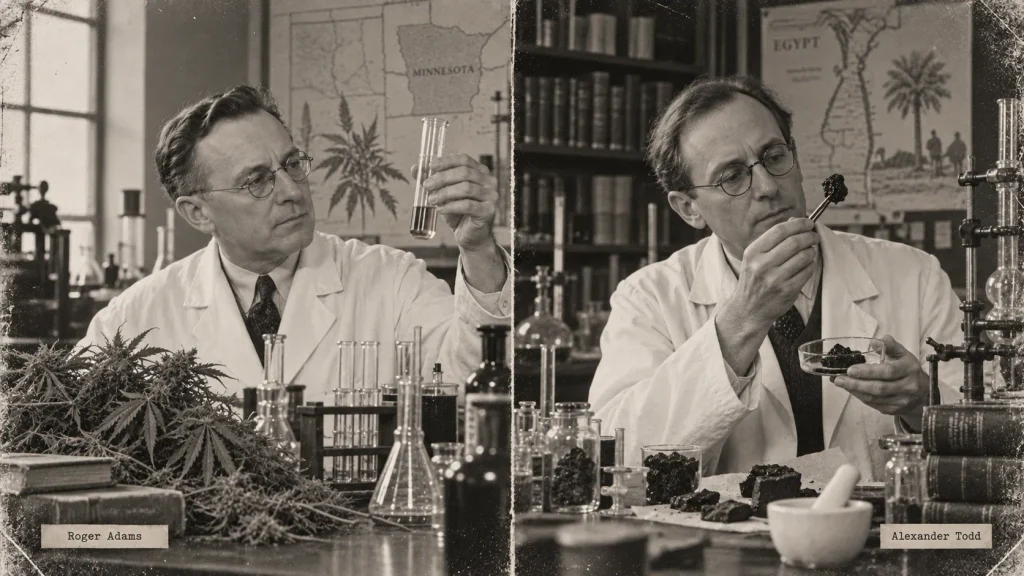
Roger Adams and his colleagues published their investigation of cannabidiol from Minnesota wild hemp in 1940. At almost the same time in Britain, a research group involving the future Nobel laureate Alexander R. Todd and chemist Anne Jacob was studying cannabis resin.
On March 2, 1940, Jacob and Todd published the Nature communication Cannabidiol and Cannabol, Constituents of Cannabis indica Resin. Their starting material was Cannabis indica resin, rather than the Minnesota wild hemp used by Adams’ group.
Another British paper from the same research programme described the isolation of cannabidiol from Egyptian hashish.
For that reason, the phrase “Roger Adams discovered CBD” works as a convenient shorthand, but it compresses a more complicated scientific history. A more precise summary is:
- Roger Adams and his colleagues isolated and investigated CBD from Minnesota wild hemp and published major work in 1940.
- Anne Jacob and Alexander R. Todd independently reported cannabidiol in cannabis resin during the same year.
- The structure of CBD was refined later, with important work continuing into the 1960s.
Why Was the Structure of CBD Still Uncertain in 1940?
Chemists working in 1940 did not have the analytical tools available to modern research laboratories. Techniques such as modern high-resolution nuclear magnetic resonance spectroscopy and today’s advanced mass-spectrometric systems were not available to Adams.
Adams and his collaborators established many chemical properties of cannabidiol and came remarkably close to the modern structural picture. Some structural and stereochemical questions nevertheless remained unresolved.
In 1963, Raphael Mechoulam and Yechiel Shvo published Hashish—I. The structure of cannabidiol in Tetrahedron. Their work established the central structural framework used for CBD today.
The story did not end there. In 1964, Czechoslovak chemist František Šantavý published Notes on the structure of cannabidiol compounds, contributing to the determination of the double-bond position and absolute configuration of naturally occurring CBD.
This distinction matters historically: 1940 marks the early isolation and intensive chemical investigation of CBD, while 1963 and 1964 represent decisive steps toward the structure and configuration recognised today.
Roger Adams’ CBD Patent
Adams’ work did not remain confined to academic journals. On August 16, 1940, he filed a US patent application covering a process for isolating cannabidiol.
The patent is US2304669A, titled Isolation of Cannabidiol. It was granted on December 8, 1942.
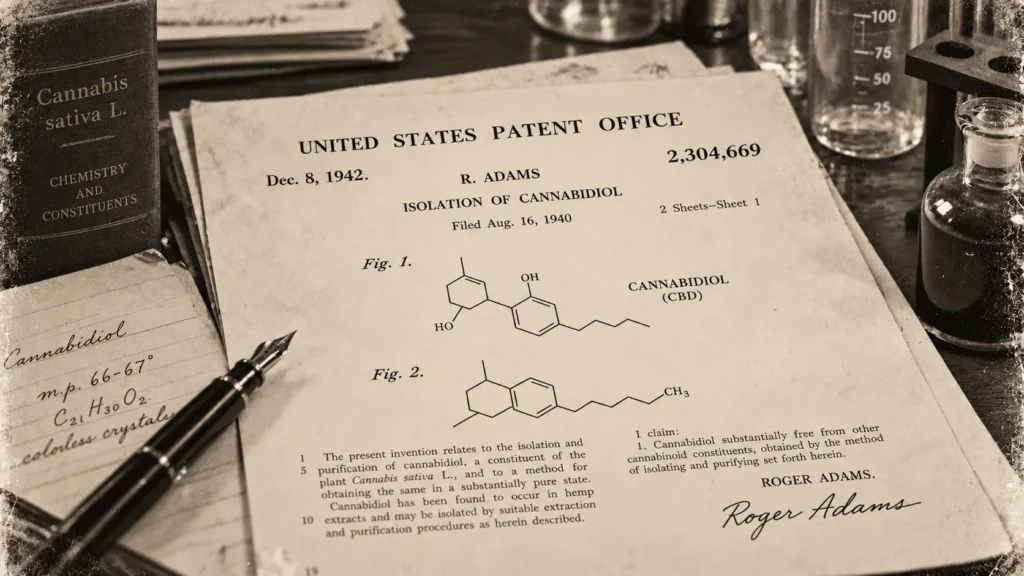
The patent itself refers to the earlier 1940 research and describes an improved process for separating cannabidiol from hemp-derived red oil.
One piece of historical terminology needs context. The patent describes cannabidiol as physiologically inactive with respect to the “marihuana activity” being investigated at the time. That should not be translated into the modern claim that CBD is simply “inactive” or “does nothing.” In its historical context, the wording referred to the absence of the characteristic intoxicating activity associated with cannabis.
CBD, THC and a Discovery Adams Could Not Yet See Completely
The Minnesota research programme did not focus on CBD alone. Adams and his colleagues also investigated cannabinol (CBN) and chemical transformations of cannabidiol.
During 1940, the group published experiments in which CBD was converted into compounds described as tetrahydrocannabinols. But the precise identity and natural significance of delta-9 THC had not yet been resolved in the way it would be later.
In 1964, Yechiel Gaoni and Raphael Mechoulam reported the isolation, structure and partial synthesis of delta-9 THC from hashish. Their work formed another major milestone in a scientific path that had begun more than two decades earlier with investigations of CBD, CBN and related cannabis constituents.
For a broader introduction to the compounds themselves, see Cannabinoids: CBD, THC, CBG and Other Compounds Explained and our comparison of CBD vs THC.
Why Minnesota Wild Hemp?
Modern commercial hemp is usually associated with selected cultivars, controlled production and defined cannabinoid profiles. The landscape of the late 1930s was very different.
Wild or feral hemp populations had become established across parts of the American Midwest. To many authorities, this cannabis was an unwanted roadside plant. To chemists trying to understand the constituents of cannabis, however, it represented an accessible botanical source for research.
That creates one of the historical paradoxes of the CBD story. A plant population often treated as a weed supplied the material for research that helped establish modern cannabinoid chemistry — chemistry that would eventually underpin a global CBD industry.
Timeline: From Minnesota Hemp to the Modern Structure of CBD
| Year | Event |
|---|---|
| 1938 | The Minnesota wild hemp later used in the experiments grows during the season and is harvested in August. |
| 1939 | Collaboration develops between Roger Adams’ laboratory and the US Treasury Department Narcotics Laboratory. |
| 1940 | Adams, Hunt and Clark publish their major paper on cannabidiol isolated from Minnesota wild hemp. |
| March 2, 1940 | Anne Jacob and Alexander R. Todd report cannabidiol in Cannabis indica resin in Nature. |
| August 16, 1940 | Roger Adams files his US patent application for a method of isolating cannabidiol. |
| December 8, 1942 | US Patent 2,304,669 is granted. |
| 1963 | Raphael Mechoulam and Yechiel Shvo publish their major structural study of cannabidiol. |
| 1964 | František Šantavý publishes further structural and stereochemical work on CBD; Gaoni and Mechoulam report the isolation and structure of delta-9 THC. |
What Popular CBD History Often Gets Wrong
Short histories of CBD often collapse several separate scientific milestones into a single “discovery date.” That makes the story easier to tell, but less accurate.
- “CBD was fully understood in 1940.” Not quite. Isolation and major structural work took place in 1940, but important structural questions were resolved later.
- “Roger Adams was the only person who discovered CBD.” Adams’ contribution was fundamental, but Jacob and Todd independently reported cannabidiol from different cannabis material during the same year.
- “Raphael Mechoulam discovered CBD.” Mechoulam played a central role in the later structural clarification of CBD, but cannabidiol had already been isolated and investigated in 1940.
- “The CBD structure was completely settled in 1963.” Mechoulam and Shvo established the correct central structure in 1963; Šantavý contributed further clarification in 1964, including stereochemical details.
- “The famous 1940 CBD came from specially bred medicinal hemp.” The material was wild or feral hemp from Minnesota.
Why the 40-Kilogram Story Still Matters
Many historical CBD articles focus only on famous names and years. The Minnesota case is more revealing because the physical path of the research material can be reconstructed unusually well: wild hemp, harvest timing, drying, stem removal, large-scale government-laboratory extraction, about 100 grams of red oil and then chemical investigation at the University of Illinois.
That means the beginning of modern CBD research can be understood as more than a date on a timeline. It was a concrete chain connecting a plant population, federal laboratory facilities, academic chemists, journal papers and eventually a patent.
This is why “Minnesota wild hemp” deserves more than a footnote in cannabis history. An unremarkable population of Midwestern hemp became one of the botanical starting points for modern cannabinoid chemistry.
CBD was isolated and intensively investigated by multiple researchers around 1940, while the structure recognised today emerged through later work, especially during the 1960s.
Sources and Original Documents
This reconstruction prioritises original scientific papers, patent documents and later scholarly histories of cannabinoid research.
- Adams R., Hunt M., Clark J. H. (1940). Structure of Cannabidiol, a Product Isolated from the Marihuana Extract of Minnesota Wild Hemp. I. Journal of the American Chemical Society 62, 196–200. DOI: 10.1021/ja01858a058.
- Adams R., Pease D. C., Clark J. H. (1940). Isolation of Cannabinol, Cannabidiol and Quebrachitol from Red Oil of Minnesota Wild Hemp. Journal of the American Chemical Society 62, 2194–2196. DOI: 10.1021/ja01865a080.
- Adams R. — US Patent 2,304,669. Isolation of Cannabidiol. Filed August 16, 1940; granted December 8, 1942.
- Jacob A., Todd A. R. (1940). Cannabidiol and Cannabol, Constituents of Cannabis indica Resin. Nature 145, 350. DOI: 10.1038/145350a0.
- Jacob A., Todd A. R. (1940). Cannabis Indica. Part II. Isolation of Cannabidiol from Egyptian Hashish. Observations on the Structure of Cannabinol. Journal of the Chemical Society, 649–653. DOI: 10.1039/JR9400000649.
- Mechoulam R., Shvo Y. (1963). Hashish—I. The structure of cannabidiol. Tetrahedron 19(12), 2073–2078. DOI: 10.1016/0040-4020(63)85022-X.
- Šantavý F. (1964). Notes on the structure of cannabidiol compounds. Acta Universitatis Palackianae Olomucensis, Facultatis Medicae 35, 5–9.
- Gaoni Y., Mechoulam R. (1964). Isolation, Structure, and Partial Synthesis of an Active Constituent of Hashish. Journal of the American Chemical Society 86(8), 1646–1647. DOI: 10.1021/ja01062a046.
- Filer C. N. (2020). Minnesota wild hemp: a crucial botanical source in early cannabinoid discovery. Journal of Cannabis Research 2, 25. DOI: 10.1186/s42238-020-00031-3.
- Appendino G. (2020). The early history of cannabinoid research. Rendiconti Lincei. Scienze Fisiche e Naturali 31, 919–929.
- National Academy of Sciences. Roger Adams — Biographical Memoir. Biographical and bibliographical information on Adams and his scientific career.
Historical scientific publications sometimes use terminology and spellings for cannabis that are no longer standard in modern scientific or general usage. They are retained here only where necessary to identify an original publication or historical document accurately.
← Back to the CBD Wiki | What Is CBD? | Cannabinoids | CBD vs THC | Cannabinoid Testing
Frequently Asked Questions About the Discovery of CBD
Who discovered CBD?
Roger Adams and his colleagues at the University of Illinois were among the central researchers in the early history of CBD and published major work on cannabidiol from Minnesota wild hemp in 1940. During the same year, Anne Jacob and Alexander R. Todd independently reported cannabidiol from Cannabis indica resin. The modern structure of CBD was clarified through later research.
When was CBD discovered?
1940 is the key year for the early scientific isolation and description of cannabidiol, but the discovery was not a single event. Important structural work continued for more than two decades, including the 1963 study by Raphael Mechoulam and Yechiel Shvo.
Where did Roger Adams’ CBD come from?
The starting material was wild or feral Cannabis sativa from Minnesota. The hemp had grown during the 1938 season and was harvested in August before being dried and processed.
How much hemp was used in the early CBD experiments?
Historical reconstructions describe a batch of approximately 40 kilograms of Minnesota hemp. After extraction and purification, it yielded about 100 grams of purified red oil used for further cannabinoid research.
Did Roger Adams patent CBD?
He did not receive a patent covering “CBD in general.” US Patent 2,304,669 covered a process for isolating cannabidiol from hemp-derived red oil. The application was filed on August 16, 1940 and the patent was granted on December 8, 1942.
When was the modern structure of CBD established?
Adams and other researchers made major structural advances in 1940. Mechoulam and Shvo published a central paper establishing the correct structural framework in 1963, while František Šantavý contributed further structural and stereochemical clarification in 1964.