

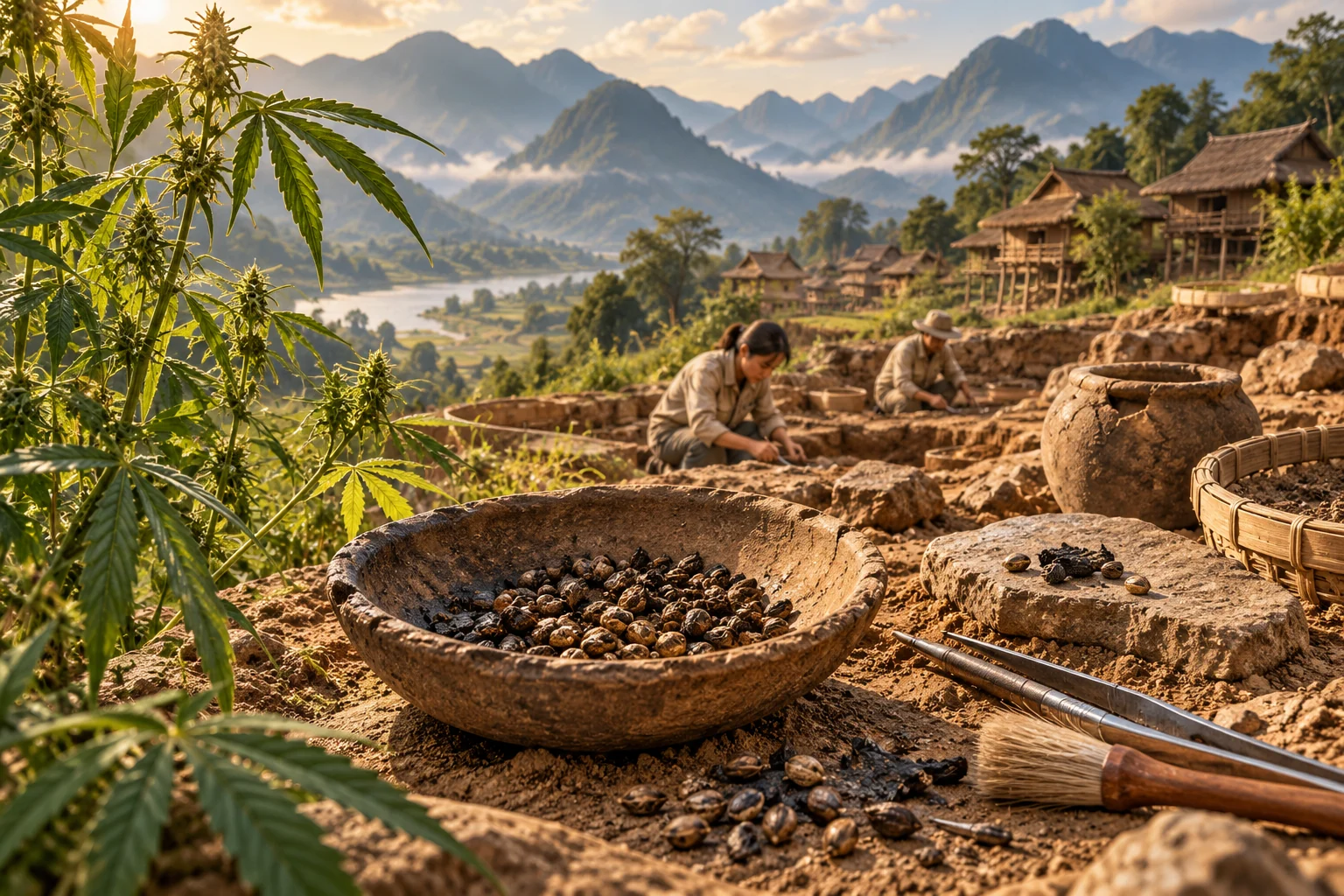
More than 800 charred cannabis fruits were recovered at Haimenkou, a Bronze Age settlement in Yunnan, China. About 700 came from one archaeological context dated to 1400–1100 BCE. These remains are evidence of an ancient crop. They cannot by themselves reveal how much THC the plants contained, or whether anybody smoked them.
Ancient China’s cannabis history involves several different questions: where the plant was domesticated, why people cultivated it, what archaeological burials contain, and how later Chinese authors wrote about hemp and medicine. This research guide separates the evidence rather than forcing it into one story. For the global chronology, see our world history of cannabis.
Six milestones: ancient cannabis evidence at a glance
| Period | Evidence | Limit |
|---|---|---|
| Early Neolithic, estimated | Genomic analysis suggests early domestication in East Asia. | Not the date of an excavated field. |
| Shang period, c. 1600–1046 BCE | Hemp textiles identified at Gaocheng Taixi. | Textiles do not prove psychoactive use. |
| c. 1400–1100 BCE | Most of over 800 cannabis fruits from Haimenkou came from one context. | Seed size does not show THC levels. |
| About 2,700 years ago | Preserved cannabis in a Yanghai burial. | Use by the living cannot be observed directly. |
| About 500 BCE | Cannabinoid residues in Jirzankal braziers. | Does not establish a universal regional practice. |
| Eastern Han to sixth century CE | Medical and farming texts describe cannabis parts and uses. | Later manuscripts are not proof of a third-millennium-BCE book. |
The dates in this table come from different kinds of investigation. Genetics reconstructs population history, archaeologists date objects in their contexts, and textual historians examine manuscripts and their transmission. Their conclusions cannot simply be combined into a single precise date for the “discovery” of cannabis.
Did cannabis originate in China? What the genomic evidence says
In a 2021 Science Advances study, Ren and colleagues sequenced a worldwide collection of 110 cannabis genomes. Their results support early domestication in East Asia, with Chinese landraces and feral populations among the closest sampled representatives of ancestral diversity. This challenges older accounts that assumed the plant must have been domesticated in Central Asia. Read the original genomic study (2021).
The often repeated figure of 12,000 years is a statistical estimate of genetic divergence, not evidence of an excavated 12,000-year-old cannabis field. Its published 95% confidence interval is approximately 6,458–15,728 years before present. The authors also suggest that some apparently wild-growing plants may descend from historical cultivation. As with all genetic models, interpretation depends on the samples available and the model used.
“Origin in East Asia” should not be confused with an assertion that the modern state of China, or a known ancient dynasty, carried out the first planting. The study addresses prehistoric biological and agricultural processes that long predate the political boundaries familiar today.
Hemp fibres and clothing: the distinction between fabric and intoxication
Hemp was useful as a fibre crop long before the chemical constituents CBD and THC had scientific names. Its stems could be processed for cloth and cordage; its fruits could supply food and oil. Archaeologists nevertheless have to distinguish hemp fibres from ramie and other plant materials. Woven impressions on pottery are evidence of textile technology, but do not necessarily identify which species was used.
A detailed archaeological study by Dal Martello and colleagues discusses a woven hemp roll from Gaocheng Taixi, Hebei, associated with the Shang period (roughly 1600–1046 BCE), while noting that several older textile claims have been disputed. Even securely identified hemp fabric tells us about fibre production, not a particular psychoactive custom. Read the Haimenkou archaeobotanical paper (online 2023, journal volume 2024).
The China National Silk Museum’s discussion of historical fabrics also explains the importance of separating hemp and ramie in archaeological collections. A popular account that labels every ancient woven remnant as cannabis may be overstating the evidence.
Haimenkou in Yunnan: a rare concentration of cannabis fruits
During the 2008 excavation season at Haimenkou in southwestern China, flotation samples yielded more than 800 charred cannabis achenes—the small fruits usually called seeds. Roughly 700 were recovered from one context dated to 1400–1100 BCE. The longer settlement sequence spans approximately 1650–400 BCE, but those dates should not all be assigned to the concentrated find.
Researchers measured a sample of 30 ancient fruits and compared their dimensions with modern plants and other archaeological material. Although seeds of crops selected for fibre or oil may differ on average from those of some drug-associated varieties, the size ranges overlap. Haimenkou therefore does not establish an ancient THC concentration or the precise purpose of each cannabis plant.
The paper proposes that this population may reflect a multipurpose crop beginning to diversify towards oilseed and fibre-adapted varieties. That is a scientifically reasoned interpretation of archaeobotanical measurements, not a chemical test showing that the ancient settlement used a modern cannabis strain.
Yanghai: preserved cannabis from a 2,700-year-old burial
At the Yanghai Tombs near Turpan, in what is now Xinjiang, researchers documented approximately 789 grams of preserved cannabis plant material in a burial around 2,700 years old. A 2008 study in the Journal of Experimental Botany combined botanical investigation, chemical tests and genetic analysis, identifying cannabinoid-related evidence in the ancient remains. Read the original Yanghai investigation (2008).
The researchers discussed possible medicinal, psychoactive and divinatory purposes. Those possibilities are not the same as witnessing someone consume the material. Yanghai also belongs to a broader Central Asian cultural setting: a find inside today’s Chinese borders should not automatically be described as a custom of every ancient Chinese society.
Jirzankal on the Pamirs: evidence of burning, not simply plant storage
The Jirzankal Cemetery provides another kind of evidence. In 2019 researchers analysed residues linked to ten wooden braziers and four burned stones. The presence of cannabinoid-related compounds, including cannabinol, supported their interpretation that cannabis was burned in burial rituals about 2,500 years ago. Read the Jirzankal chemical-residue study (2019).
It matters that Yanghai and Jirzankal are different sites with different methods of verification. At Yanghai, plants survived in the burial. At Jirzankal, residues were found on heated ceremonial objects. Neither study can establish exactly what every participant inhaled or how common the practice was across a wider population.
Early Chinese writing: hemp, seeds and medical terminology
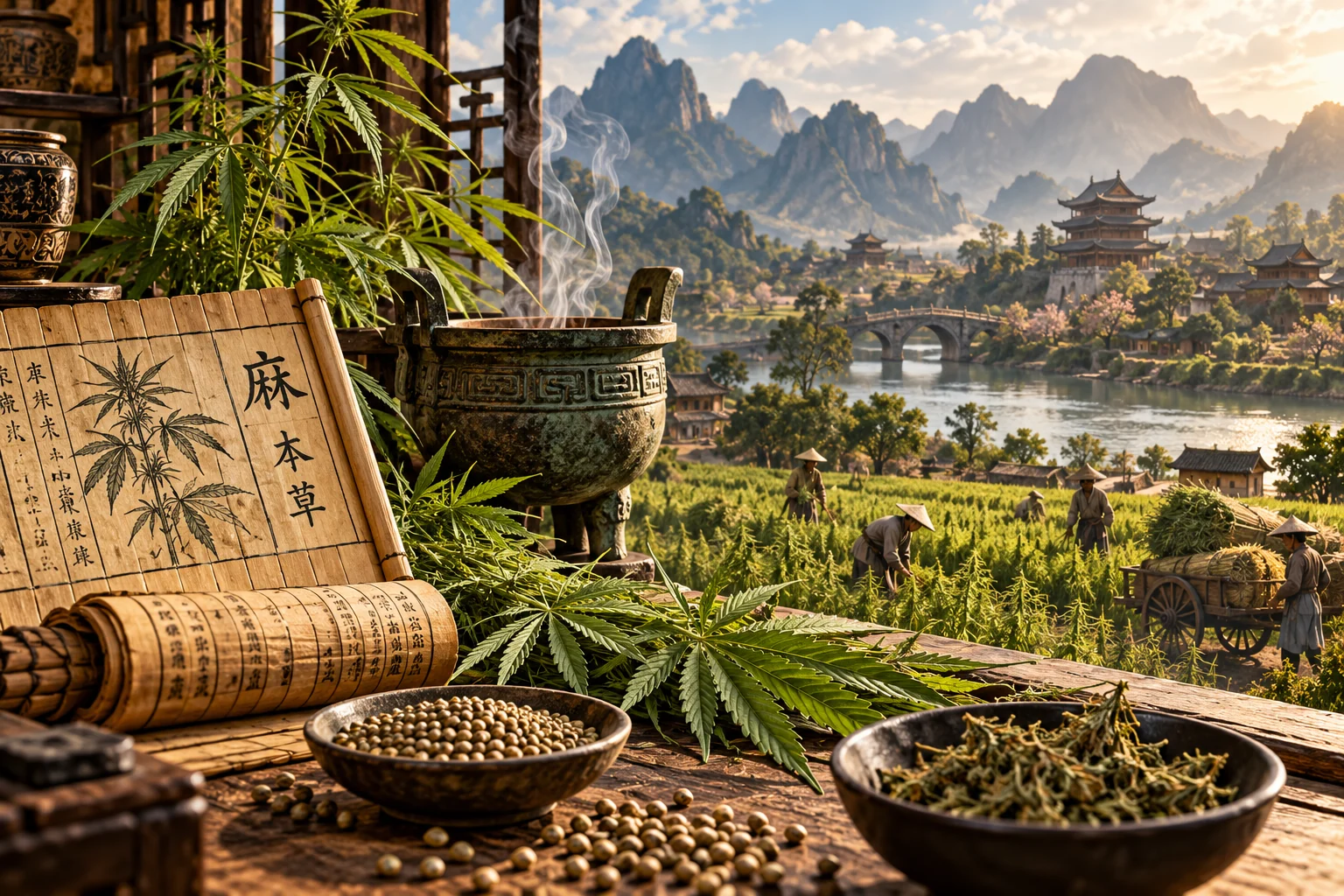
Historical Chinese texts discuss hemp as an agricultural resource and as a material used in different medical traditions. The character ma (麻), and terminology for the plant’s fruits, flowers and other parts, must be read in the context of individual works and periods. A reference to fibre or cloth cannot be converted into a claim about THC-rich flowers.
E. Joseph Brand and Zhongzhen Zhao analysed Chinese bencao (materia medica) literature across dynasties and highlighted the sixth-century farming work Qi Min Yao Shu for its detailed description of hemp cultivation, especially seed and fibre production. Their review also warns that historical plant-part names do not always map unambiguously onto modern botanical categories. Read the scholarly analysis of early Chinese medical texts (2017).
A medical text can show what an ancient or medieval author believed, but it is not modern clinical proof. Likewise, traditional descriptions involving hemp fruits should not be treated as if they concerned today’s concentrated CBD oils.
Shennong and the myth of a 5,000-year-old cannabis manual
Popular histories often say the legendary Divine Farmer, Shennong, wrote about medicinal cannabis around 2700 BCE. The Shen Nong Ben Cao Jing is indeed foundational to the Chinese materia medica tradition, but historical scholarship dates its compilation to the Eastern Han era (25–220 CE) and documents its transmission through later editions and commentary. Read the academic chronology of bencao literature.
The legendary attribution should not be mistaken for the age of an existing manuscript. The date of a figure in tradition, the date of a text and the date of an archaeological find are distinct questions. Confusing them turns a complex written history into a misleading slogan.
Ancient paper: hemp, ramie and unresolved fibre identification
A 2025 materials study investigated a fibre sheet found around a bronze mirror in a Western Han tomb at Dabuzi, Xi’an. Researchers used microscopy, spectroscopy and chemical analysis, describing the object as presumably ancient hemp paper while noting fibre traits compatible with ramie or hemp. Read the 2025 analysis of the Dabuzi tomb fibre sheet.
The qualification is important. This find helps document early plant-fibre sheets, but does not establish that the first paper in China—or every early sheet—was indisputably cannabis paper. Identification of the fibres and reconstruction of the production process remain scientific questions.
Fact-check: six common claims about ancient Chinese cannabis
| Claim | What the evidence supports |
|---|---|
| Cannabis was cultivated in China exactly 12,000 years ago. | Genomic modelling supports early East Asian domestication, with substantial uncertainty. |
| Every early Chinese fabric impression proves hemp. | Identification of the underlying plant material may be uncertain. |
| The 800+ Haimenkou seeds were high-THC cannabis. | Seed size cannot establish a THC concentration. |
| Shennong wrote a cannabis book in 2700 BCE. | The legendary attribution is not the documented date of the text. |
| Yanghai and Jirzankal prove the same ritual. | They are separate discoveries supported by different types of evidence. |
| The world’s first paper was certainly made from cannabis. | Ancient fibres require careful identification; some findings remain tentative. |
How SaveSleuth checks the historical record
For archaeology we prioritise reports of excavated objects, dating contexts and analytical methods. For Chinese texts we use named scholarship that examines earlier manuscripts and their transmission. A modern study of an ancient text is identified as scholarship, not misrepresented as an original manuscript. Interpretations are separated from observations, and scientific uncertainty is included where it materially changes a claim.
The history of cannabis in China is not the history of a single substance used for one purpose. It is the combined story of domestication, food, fibre, textiles, burial customs, medical writing and later chemical research. That is precisely why comparing source types reveals more than repeating the familiar legends.
Related SaveSleuth research
- History of Cannabis Worldwide: Archaeology, Hemp, Science and Laws
- The Discovery of CBD: Roger Adams, Minnesota Wild Hemp and 1940
- Cannabinoids
- Cannabinoid Testing
Research checked: October 21, 2026. This page is a historical and scientific source review, not medical advice, current legal advice or guidance on consumption.
Frequently asked questions
Where was cannabis first domesticated?
A large genomic study supports early domestication in East Asia, but does not identify a specific first farm or an exact year.
Why are the seeds from Haimenkou important?
Archaeologists recovered more than 800 charred cannabis fruits; most came from a context dated to 1400–1100 BCE. Their identification and archaeological context are evidence for a crop, not proof of psychoactive use.
Does the Jirzankal find demonstrate ancient smoking?
Chemical residues in burial braziers support an interpretation of cannabis burning during mortuary rituals. The finding cannot establish a universal custom.
Did Shennong write about cannabis 5,000 years ago?
A legendary attribution is not a securely dated surviving book. The classical materia medica tradition associated with Shennong belongs to a much later historical period.