
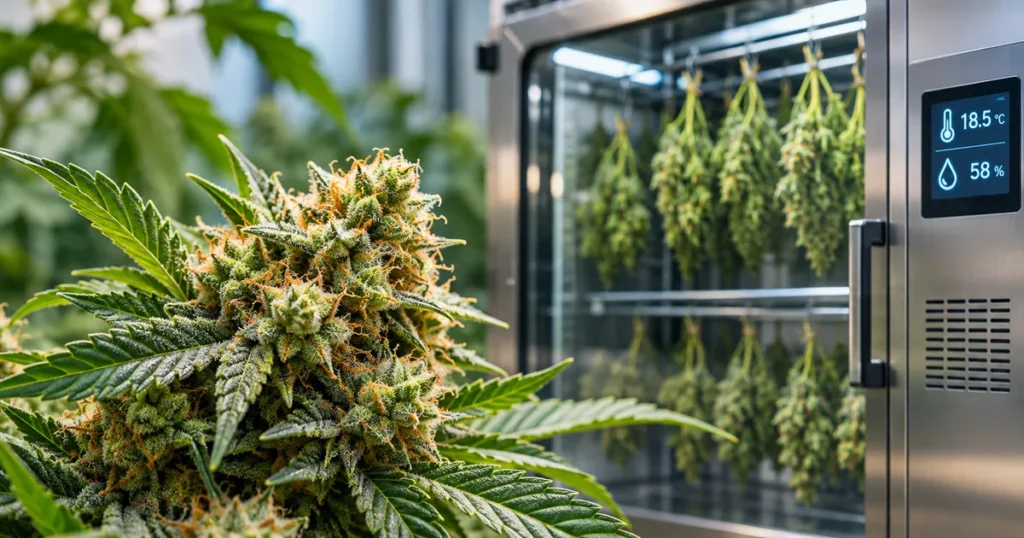
Drying is not merely the final step before cannabis flowers reach a jar. It can change their aroma, appearance and storage stability—even when the plants were grown under identical conditions. A peer-reviewed study published on 14 October 2026 compared three post-harvest methods and found that vapor pressure deficit (VPD)-controlled drying best maintained the tested flowers’ original aromatic profile. That does not mean every VPD machine produces superior CBD flower, but it gives buyers and producers a useful reason to look beyond cultivation claims.
What the 2026 drying study actually tested
Researchers examined pharmaceutical-grade Cannabis sativa flowers of the ‘Huckleberry’ cultivar. They compared freeze drying, low-temperature oven drying at 40°C, and VPD-controlled drying. The team measured moisture loss, trichome condition, colour, volatile compounds and cannabinoids. The open-access paper in the Journal of Cannabis Research reports markedly different outcomes:
- Freeze drying reached the target 12% moisture in approximately 11 hours and best preserved green colour and trichome morphology.
- Oven drying at 40°C took approximately 35 hours and caused the greatest colour and structural changes among the tested methods.
- VPD-controlled drying took six to seven days, but retained the highest essential-oil yield and the aromatic profile closest to the original flowers.
Cannabinoid composition was comparatively stable across treatments. The more pronounced differences concerned volatile compounds—particularly those that shape aroma. These results concern one cultivar under specified laboratory conditions, not every CBD strain or commercial drying room.
Why relative humidity alone does not tell the whole story
Relative humidity describes how close the air is to saturation at a particular temperature. VPD describes the difference between the amount of moisture the air could hold at saturation and the moisture actually present. Because temperature changes the saturation point, the same relative humidity can produce different drying conditions at different temperatures.
For harvested flowers, that difference matters: moisture must leave the plant material without making the exterior excessively dry while the interior remains wet. A controlled environment aims to make that process more predictable. However, VPD is not a substitute for measuring the finished product’s water activity, which helps assess the availability of water for microbial growth and storage stability.
A 2026 review in Food and Bioproducts Processing identifies water activity as a central quality and safety parameter. It also warns that poor drying and curing conditions can contribute to terpene losses and microbial contamination. Precise control therefore serves two goals that must be considered together: chemical preservation and safe storage.
Where Cannatrol Vaportrol fits in
Cannatrol markets its patented Vaportrol technology as a way to regulate vapor pressure, temperature and dew point through drying and curing. Unlike a basic humidity-only setup, the system is designed to stabilise the environment as moisture leaves the flowers.
The company cites a comparative evaluation by the Cannabis Research Coalition reporting 16% higher average total terpene retention than a conventional drying method. That figure is specific to the cited comparison: it is not a guarantee of a 16% improvement for every cultivar, facility or harvest. Cannatrol also presents trichome-related microscopy findings, but those company-promoted results should not be confused with the independent October 2026 study, which examined drying approaches rather than validating this brand.
A CBD grower’s recent announcement that it will use Vaportrol for two outdoor flower batches illustrates how such systems are moving into small-batch production. The announcement does not provide independent batch test results, so it is too early to judge whether those particular flowers retain more terpenes than previous harvests.
What earlier research says about cultivar differences
A 2024 study published in Plants tested controlled-atmosphere drying on two medicinal cannabis chemovars. It found that the best conditions for preserving individual terpene groups differed between them. Some controlled-atmosphere treatments reduced processing time while retaining volatile compounds, but the ideal settings were not identical across cultivars.
That is a useful caution against a universal “best drying method” claim. Terpene profiles, flower density, starting moisture and post-harvest handling all influence the outcome. A technology may offer more control without removing the need to validate settings for each crop.
What CBD flower buyers can check
Consumers rarely see a producer’s drying logs. They can, however, ask for evidence that goes beyond terms such as “premium,” “slow-cured” or “juicy.”
- Batch-specific testing: Look for a certificate of analysis identifying the product batch, cannabinoid content and relevant contaminants.
- Moisture and water activity: Ask whether the producer monitors both. A flower that feels soft is not automatically safer or better cured.
- Storage and packaging: Check whether the seller explains how flowers are protected from excess heat, light and humidity after curing.
- Terpene evidence: A detailed terpene analysis is more informative than an unsupported claim that a particular machine “preserves everything.”
Visual appearance and aroma can provide clues, but neither can confirm microbial safety or the exact chemical composition. Laboratory testing remains essential.
What the evidence does—and does not—show
The strongest conclusion from the October 2026 study is narrow but important: drying method changed terpene composition more than cannabinoid content in the tested material. VPD-controlled drying performed particularly well for aroma retention, while freeze drying excelled in speed and visual preservation. The study does not establish that VPD-treated CBD flowers have greater therapeutic effects, nor does it prove that a specific commercial machine is superior.
For producers, the next meaningful comparison is batch-level data: terpene measurements before and after drying, final water activity, microbial testing and consistent results across harvests. For buyers, these records matter more than the equipment name on a marketing page.
Sources
- Mallis et al. (2026), Journal of Cannabis Research — comparison of freeze, oven and VPD drying.
- Food and Bioproducts Processing (2026) — review of drying, curing, water activity and microbial safety.
- Plants (2024) — cultivar-specific controlled-atmosphere drying.
- Cannatrol — company-published comparative research claims.