
Lost Connections Review UK — Is It Worth Reading?
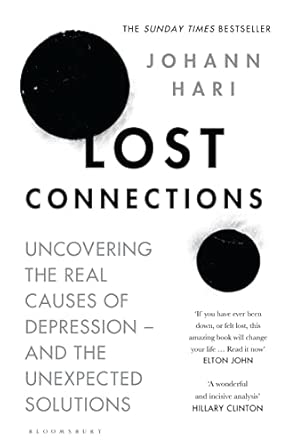
Lost Connections by Johann Hari is one of the best-known mental health books for readers who want something broader than a personal memoir or a standard self-help guide. The book argues that depression and anxiety are often tied not only to biology, but also to loneliness, disconnection, stress, meaning, and the way modern life is structured. This review looks at what the book does well, where it feels weaker, and the kind of reader it is most likely to help.
Quick Verdict
Lost Connections works best as a thought-provoking mental health book for readers who want a wider conversation about depression and anxiety. Its biggest strength is perspective. Johann Hari pushes past the usual narrow explanations and makes the reader think about social, emotional, and environmental causes of distress. The main limitation is that the book can feel more argumentative than balanced in places. Readers who want a cautious clinical guide may find it too sweeping or too confident in some of its conclusions.
Key Facts at a Glance
- Author: Johann Hari
- Format reviewed: Amazon UK paperback edition
- Main topics: depression, anxiety, loneliness, work, meaning, connection, modern life
- Book type: narrative nonfiction / mental health reporting
- Best for: readers who want a wider view of why people struggle
What the Book Is About
This is not a memoir in the usual sense, and it is not a step-by-step self-help book either. Johann Hari combines personal reflection with reporting, interviews, and a wider argument about why so many people feel depressed, anxious, disconnected, or emotionally worn down.
The central idea is simple but ambitious: a lot of mental distress may be linked to the way people live now, including social isolation, unstable work, lack of meaning, weak community, and damaged connection to other people. Whether you fully agree with every part of that argument or not, the book clearly wants readers to think beyond the most familiar explanations.
What the Book Does Well
The book’s biggest strength is range. It opens up a larger conversation about depression and anxiety than many mainstream books do. That makes it especially useful for readers who feel that purely medical or purely motivational explanations do not fully match their experience.
It is also highly readable. Johann Hari writes like a journalist rather than a clinician, which helps the book move quickly even when the subject matter is serious. For many readers, that will make the ideas more accessible than a textbook-style mental health title.
Another strong point is that it gives readers language for forms of suffering that are often treated as private failure. The book’s emphasis on disconnection, social pressure, and lack of meaning will likely resonate with readers who feel that their distress does not fit into a neat medical box.
Where It Feels Weaker
The main weakness is that the book can feel one-sided at times. Because it is pushing a strong argument, some readers may feel that competing viewpoints, clinical nuance, or limits in the evidence do not always get enough space.
It is also less useful if you want immediate practical help. The ideas may be powerful, but this is not a workbook and it does not give the kind of structured daily tools that some readers expect from a mental health title.
Pros and Cons
✅ Pros
- Strong, memorable perspective on depression and anxiety
- Readable and engaging journalistic style
- Broadens the conversation beyond narrow explanations
- Good for readers interested in social and emotional causes
- Often thought-provoking and discussion-worthy
❌ Cons
- Can feel too sweeping in places
- Not a practical step-by-step guide
- Some readers may want more clinical balance
- More argument-driven than purely neutral
Who Is It Best For?
✅ Buy it if:
- You want a broader view of depression and anxiety
- You are interested in social causes of distress
- You prefer narrative nonfiction to textbook psychology
- You like books that challenge mainstream assumptions
- You want insight more than exercises
❌ Skip it if:
- You want a therapy workbook or daily techniques
- You prefer strictly clinical or highly cautious mental health books
- You dislike argumentative nonfiction
- You want a short and very focused guide
Writing Style and Readability
This is one of the book’s strongest areas. Johann Hari writes in a clear, persuasive style that makes large ideas easy to follow. The tone is serious, but the book is never dry. For many readers, that will be a major reason it feels more approachable than more formal mental health titles.
The flip side is that the same style can make the argument feel stronger and more settled than some readers will be comfortable with. Whether that feels energising or frustrating depends a lot on what kind of nonfiction you enjoy.
Is It Good for Depression or Anxiety?
Yes, especially for readers who want to think about depression and anxiety in a wider way. The book can be valuable if you feel that your struggles are tied not only to inner chemistry, but also to loneliness, pressure, work, purpose, and the shape of your life. It is less useful if your main goal is immediate practical coping tools.
It is also worth being clear that a book like this should not be treated as a replacement for professional medical or mental health support.
Where to Buy in the UK
The Amazon UK paperback edition is available now, and other editions or formats may appear depending on the listing and date.
📘 View Lost Connections on Amazon UK ↗
Related mental health book reviews
If you want to compare this wider mental health book with other titles on Amazon UK, these reviews are good next steps.
- Reasons to Stay Alive review — a more personal memoir about depression, panic, and recovery.
- Why Has Nobody Told Me This Before? review — a broader and more structured mental health guide with practical tools.
- Maybe You Should Talk to Someone review — a therapy-focused book with a more narrative and reflective angle.
For a broader overview, visit our Amazon UK mental health books page.
Frequently Asked Questions
Is Lost Connections worth reading?
Yes, especially if you want a wider and more thought-provoking book about depression and anxiety. It is less suitable for readers who mainly want practical exercises or a clinical guide.
What is Lost Connections about?
It is a mental health nonfiction book by Johann Hari that argues depression and anxiety are often linked to disconnection, loneliness, lack of meaning, pressure, and wider social conditions, not only biology.
Is this a self-help book?
Not in the usual workbook sense. It is closer to narrative nonfiction and reporting, with ideas and reflection rather than daily exercises.
Is it good for anxiety too?
Yes. The book discusses both anxiety and depression, and many of its key ideas are about the wider conditions that can fuel both.
Who should skip this book?
Readers who want a short, practical, clinically focused guide may prefer something more structured and less argumentative.
Some links on this page may be affiliate links. See our Affiliate Disclosure.