

YUSMAN F11 Jump Starter Review UK: 5000A, Diesel Cars & Long Parking
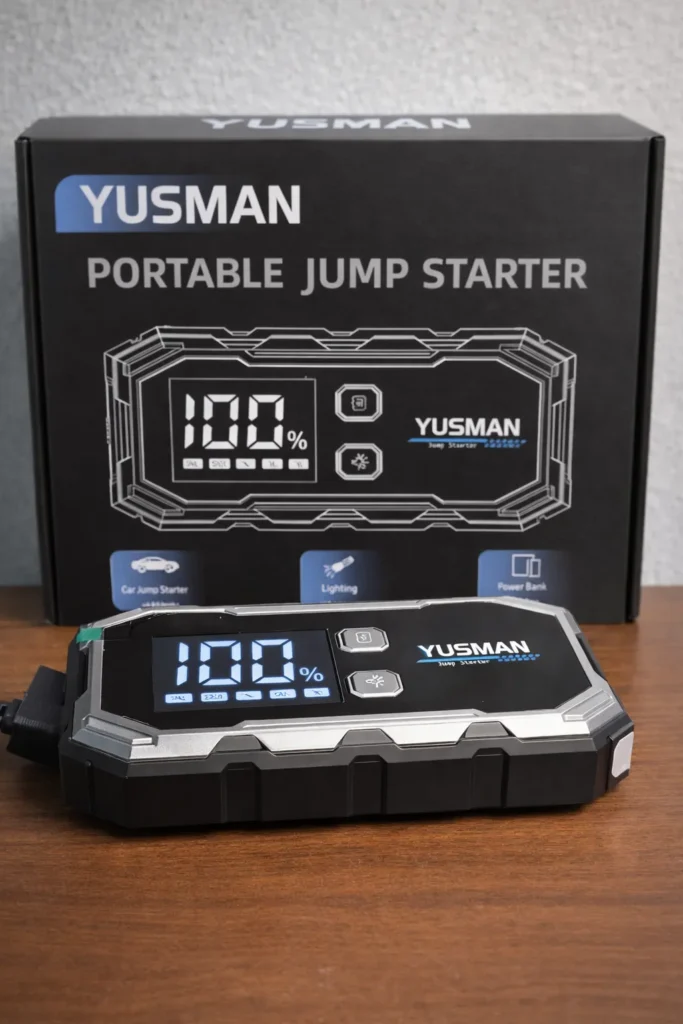
The YUSMAN F11 jump starter is a compact 12V car battery booster aimed at UK drivers who want an emergency backup for flat batteries, long parking, airport car parks, cold mornings, and cars that sometimes sit unused for weeks.
This YUSMAN F11 Jump Starter Review UK looks at the claimed 5000A peak current, petrol and diesel support, smart clamps, power bank features, Volkswagen Tiguan use, common mistakes, safety points, and whether it makes sense as a boot backup.
- Best for: emergency car starts, long parking, airport returns, and 12V vehicle backup
- Claimed peak current: 5000A
- Engine support: petrol up to 7.0L and diesel up to 5.0L, according to the listing
- Main risk: poor clamp contact, low charge, or trying to use it on the wrong type of fault
Bottom line: the YUSMAN F11 makes sense if you want a compact jump starter for weak or drained batteries after long parking. It is not a magic fix for every no-start problem, but it can be a useful backup if you keep it charged and use it correctly.
Quick Verdict: Is the YUSMAN F11 Worth Buying?
Yes, the YUSMAN F11 is worth considering if you want a compact emergency jump starter for a 12V car that may sit unused for long periods. It is especially relevant for airport parking, winter storage, second cars, occasional-use vehicles, and drivers who do not want to depend on another car or a tow truck every time the battery goes flat.
The important point is expectation. This device is best for a weak or drained battery. It is not a replacement for a healthy battery, regular battery maintenance, or proper diagnosis if the car has a deeper electrical or mechanical fault.
Best For
- Drivers who leave a car parked for weeks at a time
- Airport parking, holiday parking, and long-stay car parks
- Volkswagen Tiguan owners who want a backup for flat battery situations
- Petrol and diesel car owners within the listed engine limits
- People who want a compact boot tool rather than a bulky garage-style jump pack
- Drivers who also want USB power bank features for phones and small devices
Not Ideal For
- Cars with a damaged, leaking, frozen, or internally failed battery
- Vehicles with a no-start issue not caused by battery weakness
- Drivers who will forget to recharge the jump starter every few months
- People who want a professional diagnostic tool rather than an emergency booster
- Anyone uncomfortable working near a car battery
YUSMAN F11 Specs at a Glance
These are the key listing claims and practical details to check before buying. Exact bundle contents and accessories can vary, so always confirm the current Amazon UK listing.
| Feature | YUSMAN F11 detail |
|---|---|
| Product type | Portable 12V car jump starter |
| Claimed peak current | 5000A |
| Claimed capacity | 12800mAh |
| Petrol engine support | Up to 7.0L, according to the listing |
| Diesel engine support | Up to 5.0L, according to the listing |
| Vehicle type | 12V vehicles |
| Display | Screen for charge/status information |
| Clamps | Smart clamps with indicator lights |
| Extra use | USB power bank function for small devices |
| Claimed starts per charge | Up to 40 starts, according to the listing |
| Maintenance advice | Recharge every 2–3 months |
Why I Started Looking at Jump Starters
One time I flew away on holiday and left my Volkswagen Tiguan in an airport car park for a full month. When I came back, I got in, pressed start, and all I got was a weak click. Volkswagens can do this, especially when the battery is no longer fresh, the car has been standing for weeks, and there has been a small drain somewhere in the background.
That time I ended up wasting hours trying to sort out a tow truck. After a flight, that is the last thing anyone wants. The tow was not cheap, the car went to the nearest service point, and the answer was simple: the battery had gone flat.
That is the kind of situation where a compact jump starter starts to make sense. Not as a gadget, and not as a cure for every car problem, but as a backup plan you keep in the boot for the exact moment when the car has sat too long and does not want to start.
Does the YUSMAN F11 Make Sense for a Volkswagen Tiguan?
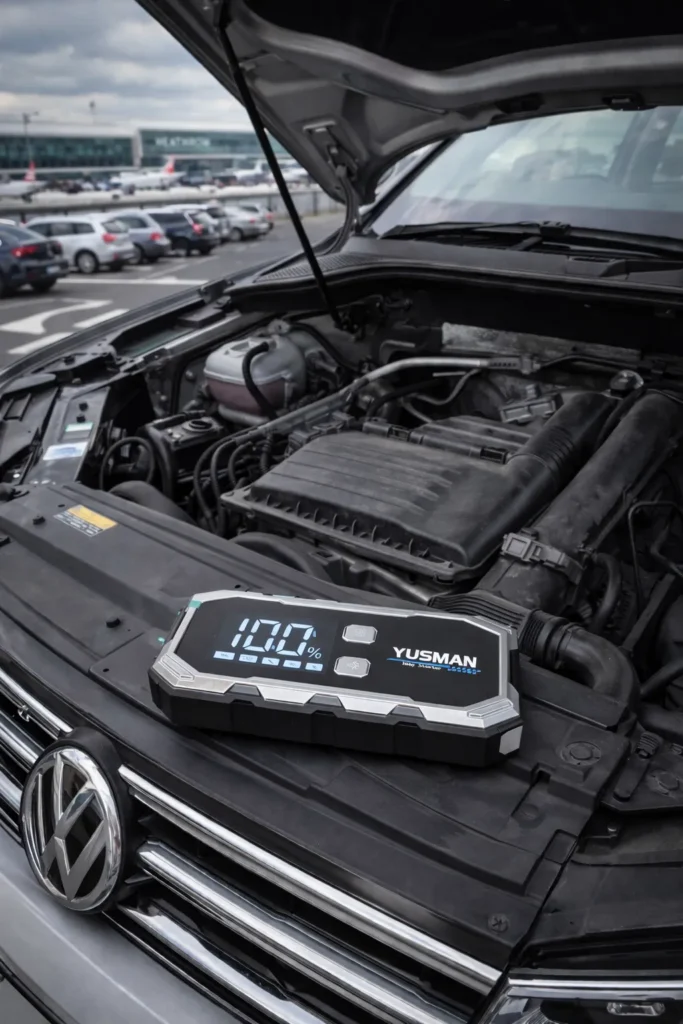
For a Volkswagen Tiguan, the YUSMAN F11 looks logical on paper. The listed petrol and diesel engine support is comfortably above what a normal Tiguan usually needs, so the claimed spec gives enough headroom for this kind of crossover.
The better question is not only “is it powerful enough?” The better question is “what caused the no-start problem?” If the battery has dropped too low after long parking, a jump starter may help. If the battery is internally failed, badly damaged, or the car has another fault, the jump starter may not solve it.
What I Like About the YUSMAN F11
The size is a big part of the appeal. It does not take over half the boot, it does not need a heavy tool bag, and it does not feel like an old garage jump pack. You can keep it in the car and check the charge from time to time.
The display is useful because it shows the charge level. That matters if you want the device ready before a long trip. A jump starter sitting in the boot at low charge is not a proper emergency plan.
The smart clamps are another important point. Indicator lights help show whether the connection is correct. That is useful because a lot of failed jump-start attempts come from poor clamp contact, incomplete connection, or rushing the setup.
Common Mistakes With the YUSMAN F11
The YUSMAN F11 is not difficult to understand, but it is easy to use carelessly. These are the mistakes I would avoid.
1. Putting It in the Boot Without Charging It First
The first easy mistake is throwing it into the boot straight after delivery and assuming it is ready. I would not do that. If I planned to rely on it after long airport parking, I would fully charge it before the trip.
2. Ignoring the Smart Clamp Indicators
The clamp lights are there for a reason. A steady correct indicator usually means the connection is ready. A warning light, flashing signal, beep, or unclear status should make you stop and check the connection, not keep trying in a panic.
3. Rushing the Connection
With a jump starter, it is not enough to get the colours roughly right. The smart-clamp plug needs to be pushed in properly, and the clamps need clean, firm contact. Poor contact can make a working jump starter look useless.
4. Trying Again and Again Without Pausing
If the car does not start on the first attempt, do not keep cranking. Stop, check the contact, remove the clamps if needed, wait a short while, reconnect properly, and try again calmly. Repeated rushed attempts can trigger protection behaviour or drain the unit faster.
5. Forgetting to Recharge It Every Few Months
A jump starter is only useful if it has enough charge when you need it. The listing mentions recharging every 2–3 months. That is especially important if it lives in the boot and you do not look at it often.
How I Would Use It After Long Parking
If I were keeping the YUSMAN F11 in a Tiguan specifically for airport parking or long-stay use, I would keep the routine simple.
- Fully charge the jump starter before the trip.
- Pack the clamps and cable with the unit.
- Keep it somewhere easy to reach, not buried under luggage.
- Check the battery level before leaving the car for a long period.
- If the car does not start, read the clamp indicators before trying.
- Make one calm start attempt rather than repeated rushed cranking.
- If the engine starts, remove the clamps promptly and safely.
- Recharge the jump starter again after use.
YUSMAN F11 Pros and Cons
Pros
- Compact enough to keep in the boot
- Useful backup for long parking and flat battery situations
- Claimed support for petrol engines up to 7.0L and diesel engines up to 5.0L
- Display makes charge level easier to check
- Smart clamps help reduce simple connection mistakes
- USB power bank function adds extra emergency use
- More practical than waiting for help in some flat battery situations
Cons
- Needs regular recharging to stay useful
- Not a fix for every no-start problem
- May not help with a badly damaged or internally failed battery
- Incorrect clamp contact can make it seem like it does not work
- Claimed peak current should not be treated as a guarantee in every situation
- Requires basic care and attention around a car battery
YUSMAN F11 vs Calling Roadside Assistance
A jump starter does not replace roadside assistance, but it can reduce the chances of needing it for a simple flat battery. That is the real value. If your car is parked at an airport, outside your home, or somewhere inconvenient, being able to attempt a safe jump start can save time and stress.
Roadside help is still the better choice if you are unsure what caused the problem, if the battery looks damaged, if the car behaves strangely after starting, or if repeated attempts fail. A jump starter is a backup tool, not a full diagnosis.
Where to Buy the YUSMAN F11 in the UK
The YUSMAN F11 is available on Amazon UK. Before buying, check the current price, bundle contents, warranty information, and recent buyer feedback. Also confirm that the listed engine support matches your vehicle.
Final Verdict: Should You Buy the YUSMAN F11?
The YUSMAN F11 is a sensible emergency tool if you want a compact jump starter for a car that may sit unused for long periods. For a Volkswagen Tiguan parked at an airport for weeks, the idea makes sense: keep a charged unit in the boot, make sure the clamps are with it, and you have a backup if the battery drops too low.
The main weakness is not the idea of the product. It is user routine. If you forget to charge it, bury it under luggage, ignore the clamp indicators, or expect it to fix a dead battery with an internal fault, it can disappoint. Used properly, it is a practical boot backup rather than a magic button.
YUSMAN F11 FAQ
Is the YUSMAN F11 suitable for a Volkswagen Tiguan?
Based on the listed specs, yes. The YUSMAN F11 is advertised for 12V vehicles, petrol engines up to 7.0L, and diesel engines up to 5.0L, which gives enough headroom for a normal Volkswagen Tiguan. Real results still depend on battery condition and the actual cause of the no-start issue.
Can the YUSMAN F11 start a diesel car?
According to the listing, it supports diesel engines up to 5.0L. That should cover many normal diesel cars and SUVs, but always check the exact vehicle, battery condition, and product manual before relying on it.
Do I need to fully charge the YUSMAN F11 before first use?
Yes. It is best to fully charge the jump starter before first use, especially if you plan to keep it as an emergency backup for long parking or airport returns.
How often should I recharge the YUSMAN F11?
The listing recommends recharging it every 2–3 months. That is a sensible routine if the unit stays in the boot and is not used often.
What should I do if the car does not start on the first attempt?
Do not keep cranking repeatedly. Stop, check the clamp contact, check the indicator lights, wait a short while, reconnect properly, and try again calmly. If the car still does not start, the problem may not be a simple flat battery.
Why can a jump starter beep or go into protection mode?
That can happen because of poor clamp contact, reverse polarity, incomplete connection, too many repeated attempts, or low charge in the jump starter. The exact meaning depends on the device indicator, so check the manual before continuing.
Can I keep the YUSMAN F11 in the boot?
Yes, that is one of the most practical ways to use it. Keep it somewhere easy to reach, store the clamps with it, and check the charge every few months.
Does the YUSMAN F11 fix every no-start problem?
No. It is mainly useful for weak or drained battery situations. If the battery is damaged, the starter motor has failed, there is an electrical fault, or the car has another issue, a jump starter may not solve the problem.